
Customer Review Scraping: Use Cases, Methods, and Challenges
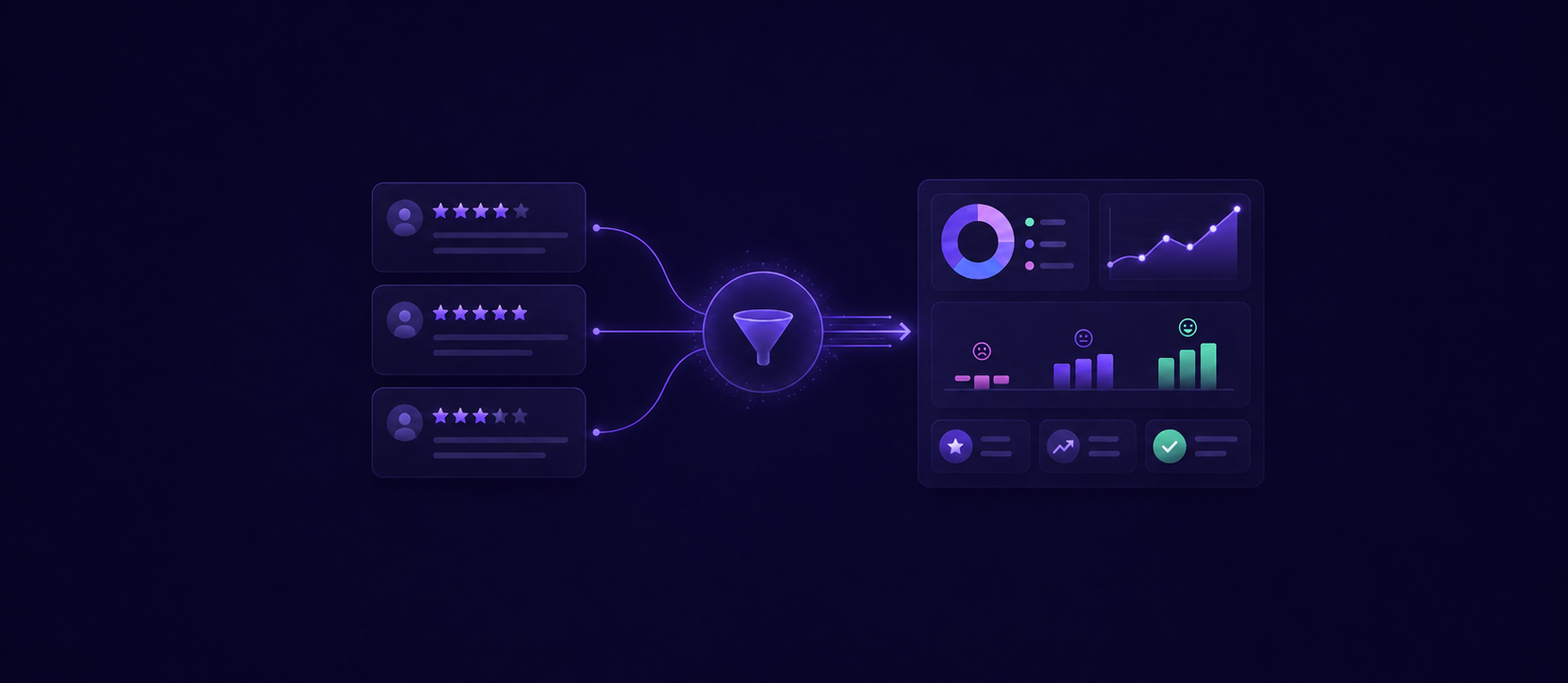
Reviews shape how people buy. According to BrightLocal's 2026 Local Consumer Review Survey, 97% of consumers read online reviews before choosing a business, and 41% say they always check reviews when browsing. That second number jumped from 29% the prior year. Research from the Northwestern Spiegel Research Center shows that products with five or more reviews see conversion rates increase by as much as 270%.
For consumers, reviews are a trust signal. For ecommerce brands and retailers, they are a data source. Customer review scraping is the automated process of collecting review content from ecommerce platforms, marketplaces, and third-party review sites, then structuring that data for analysis. When done at scale, review data feeds product development, competitive intelligence, reputation monitoring, and digital shelf analytics workflows across the organization.
This guide explains why businesses scrape customer reviews, the specific use cases that review data supports, where brands collect that data, and what it takes to do it reliably.
Why customer reviews are a strategic data source
Customer reviews combine two things that are hard to get elsewhere: qualitative feedback in a customer's own words, and quantitative signals like star ratings, review counts, and verified purchase flags. A single review tells you what one person thinks. Thousands of reviews, collected and structured over time, reveal patterns that surveys and focus groups typically miss.
Reviews are also unsolicited. Unlike a survey where you're asking specific questions, reviews reflect what customers care enough about to mention on their own. That makes them a strong signal for product strengths and weaknesses, common pain points, and emerging preferences. Research published in Electronic Commerce Research in 2025 found that aspect-based sentiment analysis of ecommerce reviews helped businesses identify the specific dimensions of their service that drive customer satisfaction, often at a level of granularity that internal data alone could not provide.
And because reviews are public, they're available for your competitors' products too. That's what makes review scraping especially valuable for ecommerce teams: it gives you structured access to customer sentiment across your category, across retailers, and across time.
How ecommerce brands use scraped review data
The business applications of review data span multiple teams. Here are the most common use cases and how they connect to real operational decisions.
Product development and quality improvement.
Mining review text for recurring complaints or praise helps product teams prioritize what to fix and what to protect. If 20% of negative reviews for a product mention the same issue, that pattern is hard to spot by reading reviews one at a time, but it shows up clearly in a structured dataset. Brands that use review data this way can reduce return rates, improve product descriptions to set better expectations, and feed real customer language back into R&D. A Tendem.ai analysis in 2026 noted that tracking feature-level sentiment across competitors helps teams identify both their own vulnerabilities and unmet needs in the category.
Competitive intelligence.
Scraping competitor reviews gives you a window into how their products perform from the customer's perspective. You can compare sentiment, track review velocity as a proxy for sales momentum, and spot weaknesses you can address in your own positioning. If a competitor's top-selling product is generating consistent complaints about durability, that's information your product and marketing teams can act on. For a deeper look at using web data for competitor benchmarking, see our guide to competitor analysis using web scraping.
Digital shelf monitoring.
For brands selling across multiple retailers and marketplaces, review counts and average ratings are part of the digital shelf. A product with strong reviews on Amazon but few reviews on a regional retailer might need a different strategy for each channel. Review data also ties directly into share of shelf visibility, because products with higher ratings and more reviews tend to rank better in marketplace search results. That means review performance feeds back into discoverability.
Sentiment analysis and trend detection.
Automated sentiment analysis classifies review text as positive, negative, or neutral, but the real value comes from going deeper. Aspect-level analysis breaks reviews down by topic, so you can see that customers love the battery life but consistently dislike the packaging. Tracking these topics over time helps teams spot emerging quality issues, seasonal patterns, or shifts in what customers value. PromptCloud's 2026 analysis of sentiment workflows noted that combining review data with social and forum signals gives brands a more complete picture of customer perception than any single source alone.
Reputation management.
Monitoring your own reviews across platforms helps catch problems early. A sudden spike in negative reviews can indicate a manufacturing defect, a shipping issue, or a change in supplier quality. By collecting reviews continuously rather than checking them manually, teams can set up alerts and respond before a small issue becomes a bigger pattern. BrightLocal's 2026 data shows that 19% of consumers now expect a response to their review on the same day they post it, up from 6% the previous year, so speed matters.
Marketing and content optimization.
Reviews are written in the language customers actually use, which makes them useful for marketing copy, product descriptions, and ad messaging. If customers consistently describe a product as "lightweight" or "easy to set up," those phrases can be tested in paid campaigns and product pages. Some brands also pull positive review language into social proof on their own sites.
Pricing strategy support.
Review sentiment and volume are useful inputs for pricing decisions. A product with strong reviews and high demand might support a price increase. A competitor with declining review sentiment might be vulnerable to a pricing move. For teams already using pricing intelligence tools, layering review data on top of competitor price feeds adds context that pricing data alone cannot provide.
Where to collect customer review data
The most common sources for review scraping include major ecommerce marketplaces like Amazon, Walmart, and Target, where the volume of reviews is highest and the data is most structured. Google Reviews and Yelp are important for local businesses and service-based companies. Retailer-specific product pages carry reviews that may differ from what's on the marketplace, since different customer segments shop through different channels.
Specialty review platforms like Trustpilot and industry-specific forums also hold valuable feedback, particularly for B2B products and niche categories. Some brands also collect reviews from their own direct-to-consumer sites.
Each platform presents its own extraction challenges. Amazon uses dynamic loading and pagination that requires browser-based scraping. Google limits API access to a small number of reviews per business. Yelp actively blocks automated access. For a broader overview of how these extraction methods work, see our guide to web scraping techniques.
How review scraping works at scale
At a basic level, review scraping involves sending automated requests to a webpage, extracting structured data from the HTML (review text, rating, date, reviewer name, verified purchase status), and storing that data in a format that's ready for analysis.
In practice, enterprise-level review collection is more involved. Reviews load dynamically on most major ecommerce sites. A product with 5,000 reviews might display ten at a time, requiring a scraper to handle pagination, scroll events, or background API calls. Platforms use anti-bot defenses like CAPTCHAs, IP rate limiting, and behavioral fingerprinting to detect and block automated access. Scrapers need proxy rotation, realistic browser emulation, and adaptive request timing to maintain reliable collection.
Once collected, review data needs normalization. The same product may appear on multiple retailers with different naming conventions, slightly different descriptions, and different review ecosystems. Matching reviews to the correct product across platforms is one of the harder problems in ecommerce data operations, especially at scale. For more on how web scraping works at a foundational level, see our explainer.
How to scrape Amazon reviews
Amazon is the highest-volume source of product reviews and the hardest to collect from at scale. Reviews load dynamically, older ones sit behind pagination and "see more" controls, and Amazon actively rate-limits automated access. Teams pull review text, star ratings, dates, verified-purchase flags and variant details to track sentiment by product and catch quality issues early. Doing it reliably means handling rendering, rotation and structure rather than a one-off script, which is where a managed platform like Import.io fits.
Scraping reviews with Python (and where teams outgrow it)
Python libraries like Beautiful Soup and Scrapy are the common starting point for review scraping, and they work for small, one-off pulls. At scale they get fragile: selectors break when a site changes, dynamic content needs a headless browser, and anti-bot defenses force you into proxy and CAPTCHA handling. Most teams reach a point where maintaining scripts costs more than the data is worth and move to a managed pipeline that self-heals when sites change.
Challenges in review data collection
Several recurring challenges make review scraping harder than it looks.
Scale and freshness. Thousands of new reviews are posted every day across major platforms. A one-time scrape is useful, but the real value comes from continuous, scheduled collection that keeps datasets current. Stale review data leads to decisions based on outdated sentiment.
Fake and incentivized reviews. Review manipulation is a well-documented problem. Platforms invest in fake review detection, but filtering is imperfect. Building trust signals into your scraped data, such as verified purchase status and reviewer history, helps separate genuine feedback from noise.
Anti-bot defenses. Major review platforms actively try to prevent automated access. Scrapers that worked last month may fail after a platform update. Maintaining reliable collection requires ongoing engineering effort, especially across multiple retailers and geographies.
Data quality and structure. Raw scraped review data is often inconsistent. The same field might be formatted differently across platforms, and edge cases like multi-variant reviews or reviews in multiple languages add complexity. Cleaning and normalizing this data is a significant part of the work.
Legal and compliance considerations. Scraping publicly available review data is generally permitted, but practices vary by platform and jurisdiction. Responsible collection means respecting robots.txt directives, avoiding personal data extraction beyond what's publicly displayed, and staying aligned with each platform's terms of service.
In-house review scraping vs. managed review data
Many teams start collecting review data with internal scripts, then discover that maintaining those scripts across multiple platforms and products becomes a significant engineering burden. The table below compares the two approaches.
How Import.io supports review data collection
Different teams have different needs when it comes to collecting and using review data. Import.io offers three ways to approach it, depending on your scale, technical resources, and how review data fits into your broader data workflow.
Import.io Data Extraction is a self-service web scraping platform. Teams can build extractors using a point-and-click interface, without writing code, and set them to run on a schedule. This works well for teams that want direct control over their data collection and have relatively focused extraction needs. If your goal is to scrape reviews from a known set of product pages or retailers on a recurring basis, the SaaS platform gives you the flexibility to set it up and manage it yourself.
Import.io Aperture is a pricing intelligence and digital shelf monitoring platform. While Aperture's core strength is competitor pricing, MAP compliance, and availability tracking, it gives brands and retailers visibility into how their products compare across channels. For teams that need review data as part of a broader competitive pricing or digital shelf workflow, Aperture connects that data to pricing decisions, assortment analysis, and market positioning in a single dashboard.
Import.io Managed Services is a fully managed data delivery offering. Import.io's engineering team builds and maintains the entire data pipeline: extraction, validation, normalization, and delivery. This is the right fit when review data needs to be collected at high scale across difficult-to-scrape sites, or when the operational burden of maintaining scrapers in-house is pulling engineering resources away from analysis. Managed Services teams also handle product matching across retailers and quality assurance, which are two of the hardest parts of review data collection at enterprise scale.
The right option depends on how much review data you need, how many platforms you need to cover, and whether your team has the engineering capacity to maintain scrapers over time. If you are not sure, contact our team for help.
