
When point-and-click isn't enough: scaling web data extraction from DIY to managed
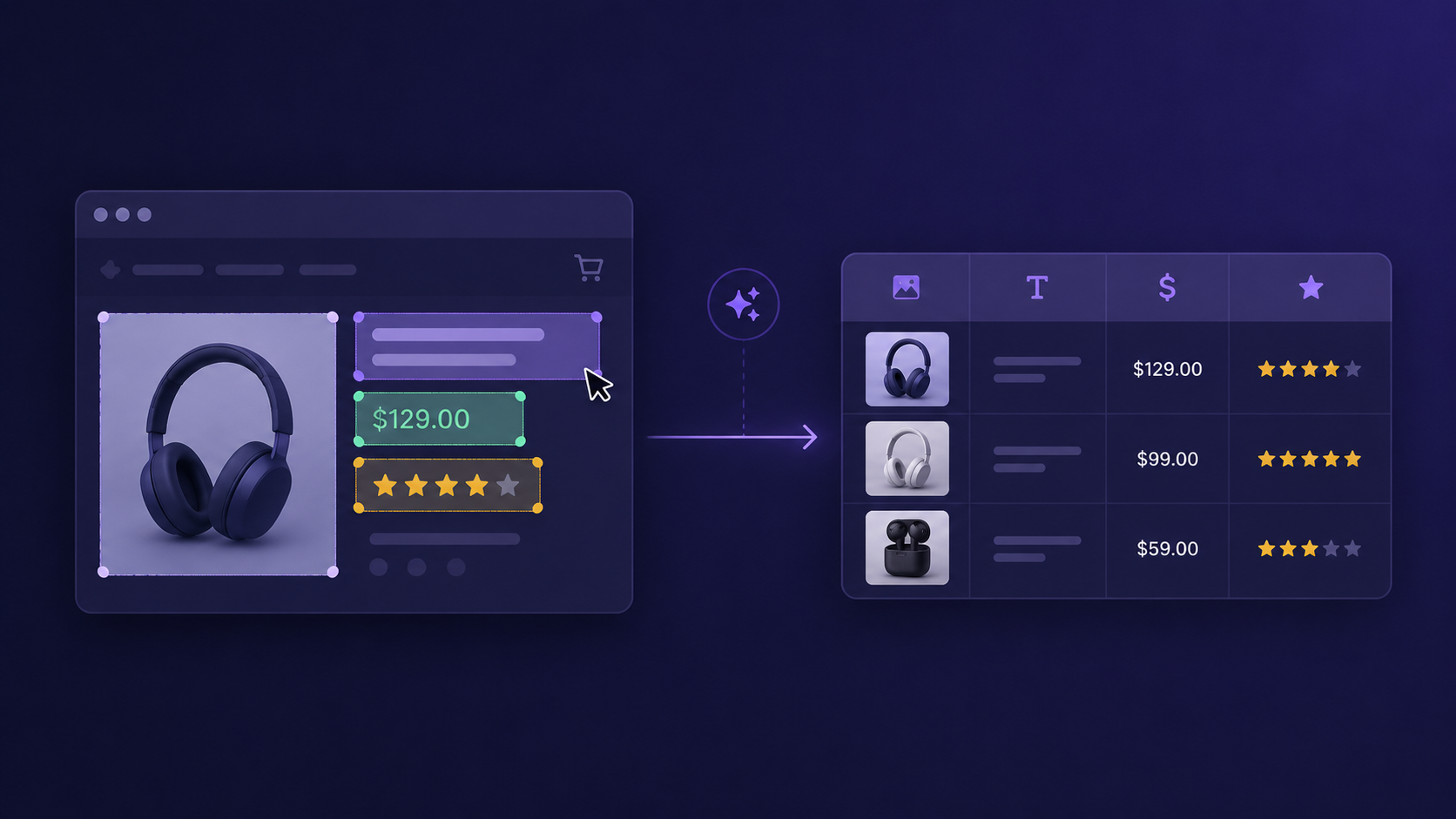
Most people who need web data start in the same place: a visual, point-and-click scraper. Paste a URL, click the fields you want, export a spreadsheet. For a lot of jobs that is the correct tool, and this guide is not here to talk you out of it.
What it will do is map what happens next, because the same project that runs cleanly on a no-code tool in month one often looks very different by month six. Targets start blocking you. A site redesign breaks your extractor overnight. The weekly export turns into a daily feed across thousands of products. Each of those moments is a rung on a ladder, and knowing which rung you are on saves you money and a good deal of frustration.
This is a buyer's-journey guide rather than a ranking. It walks from the DIY starting point up to fully managed data delivery, names the tools that fit each stage, and is clear about when you should stay exactly where you are. If you only ever need a handful of stable sources, the cheapest rung is the right one, and you can stop reading after the first section.
The point-and-click starting point
A no-code scraper turns a web page into structured rows without any code. You point at a price, a title, a rating, and the tool records the pattern and repeats it across similar pages. Octoparse offers a generous free tier and handles logins, forms, and infinite scroll. Browse AI lets you train a "robot" by demonstration and is popular for change monitoring and alerts. ParseHub and the WebScraper.io browser extension work on a similar selector-based model, and newer AI-native extensions such as Thunderbit read a page and suggest the fields for you. Import.io's own self-service platform sits in this category too, with AI field detection and scheduled exports.
For a handful of stable, lightly defended sources, these tools are all you need, and they are the fastest path from a URL to a usable dataset. A pricing analyst tracking twenty competitor products, a researcher pulling a one-off list, a category manager checking a few retailer pages each week: none of them should be building infrastructure. Start here, and stay here for as long as it works. The rung only becomes a problem when the job outgrows it, which is what the next section is about.
Where DIY starts to break
Three things tend to push a project off the first rung, and they usually arrive together.
The first is blocking. Public pages are easy to collect until they are not. Retail and marketplace sites run anti-bot systems that update constantly, and the trend runs one way. On 1 July 2025, Cloudflare, which sits in front of roughly a fifth of the web, began blocking AI crawlers by default on new domains. Operators feel it in their budgets: in the 2026 State of Web Scraping report from Apify and The Web Scraping Club, over 60% of scraping professionals said their infrastructure costs rose year on year, and 58.3 percent increased their proxy spend. A free tool with no proxy handling will simply start returning empty pages against these targets.
The second is breakage. Selector-based scrapers are tied to a page's structure, so when a retailer ships a redesign, the extractor stops matching and the data quietly goes wrong. This is the failure mode people describe as "my scrapers keep breaking," and at any real scale it becomes a standing maintenance job. PromptCloud's analysis puts ongoing scraper maintenance at around 40 percent of a dedicated engineer's time at scale, well above the 10 percent most teams budget, with in-house setups often needing a full redesign every 12 to 18 months. A newer generation of tools attacks this directly with self-healing extraction that repairs itself when a layout shifts, which is one of the clearer advances of the past two years, though it still has to get past the blocking problem first.
The third is volume. A weekly check on fifty products is a different job from a daily refresh across tens of thousands, once you multiply pages by variants by retailers by regions. Free tiers and single-machine desktop apps run out of headroom, and the work shifts from collecting data to keeping a small pipeline alive.
The scaling ladder: how needs change as you grow
The upgrade path is easier to read once you frame it as rungs rather than products. Each rung answers a specific thing that broke on the one below it.
At the entry rung you run a no-code tool or a free code library yourself, on stable sources, and you own any retraining. You move up when targets start blocking you. That usually means adding a proxy layer or a scraping API that handles fetching, rotation, and CAPTCHAs, so the pages open before any parsing begins. Reliable fetching is the hinge the whole pipeline turns on: Proxyway's 2025 Web Scraping API Report tested eleven scraping APIs against fifteen heavily protected sites and found that only four of them opened those sites reliably, so a tool's ability to reach the page matters more than anything it does afterwards.
You move up again when volume and integration become the constraint. At this stage you want scheduled refreshes, delivery over an API or webhooks into your own stack, and pricing that rewards scale. Import.io's self-service tiers, for example, run on a query-based model where each request to a site counts as a query, and the per-query rate falls as you move to a higher tier, so a project processing hundreds of thousands of queries a month costs less per unit than a small one. Residential proxies sit as an add-on for the hardest targets. The economics are worth reading closely on the pricing page, because the headline number rarely reflects the total once proxies, refresh frequency, and volume are included.
The top self-service rung still leaves one thing on your plate: you are running it. The extractors, the schedules, the proxy budget, and the fixes when something breaks are all yours. For plenty of teams that is fine. For others it is the moment to hand the whole thing over, which is the last rung.
When you stop running it yourself
Managed data delivery removes the pipeline entirely. Instead of operating tools, you agree on the sources, the fields, and the schedule, and you receive clean, validated, structured data ready to use. The provider takes on the scrapers, the proxies, the anti-bot handling, the validation, the product matching across retailers, and the delivery, and stands behind coverage and freshness. Import.io, Zyte's data services, ScrapeHero, and PromptCloud all operate in this tier.
The case for it comes down to total cost of ownership and risk. Ficstar's analysis puts in-house mid-scale scraping somewhere between 259,000 and 476,000 dollars a year once you count engineers, proxies, infrastructure, and fixes, and the maintenance line is the one that surprises people. For many sources with frequent refreshes and validation, a managed service comes in lower than rebuilding that reliability internally. Building your own tends to win only when scraping is your core product, or when you are already operating at extreme scale with the infrastructure in place. Import.io's Import.io vs in-house scraping comparison works through the trade-off in detail.
Governance is the other reason teams reach this rung. Collecting public, non-personal commercial data such as prices, listings, and reviews is broadly accepted, but the moment personal data or AI-training use enters the picture, GDPR, CCPA, and the EU AI Act's documentation requirements apply. A managed program that documents its sources, purposes, and retention, masks PII, and keeps an audit trail is far easier to defend than a collection of scripts spread across a team. For regulated retail, finance, and FMCG teams, that governed, compliant footing is often the deciding factor rather than a nice-to-have. This is the rung Import.io's managed services are built for, and for pricing and category teams specifically, Aperture turns that same reliability into decision-ready pricing intelligence and digital shelf signals rather than a raw feed to process.
The AI-native entry point
One more rung has appeared, and it sits slightly to the side of the others. If the thing consuming your web data is an AI agent rather than a person or a dashboard, the connection itself changes. The Model Context Protocol is an open standard that lets an AI application call external tools directly, and scraping providers have started exposing their platforms through it. Left to itself, an agent can read a few pages before it is blocked or its context window fills up. Connected to a scraping service over MCP, it can pull structured data from thousands of pages through real browsers and proxies and get a clean table back, with no custom integration code in between.
For teams building retrieval-augmented generation, agent workflows, or AI features that need current external data, this is the natural entry point, and it inherits the same reliability and governance questions as every rung below it. The data still has to be fetched past anti-bot defenses, structured, and made trustworthy before the model reasons over it. Import.io exposes its platform through a Web Scraper MCP for exactly this case, so an agent can request governed, structured web data as easily as it calls any other tool.
Which rung are you on?
The useful question is which rung matches your sources, your refresh frequency, and how much maintenance you want to own, rather than which tool wins in the abstract. A handful of stable pages: stay on the no-code rung and enjoy how cheap it is. Defended targets or a broken-scraper problem: add proxies, an unblocking API, or a self-healing tool. Many sources, frequent refreshes, and data that feeds real decisions: managed delivery usually wins on cost and reliability. An agent doing the consuming: connect over MCP. Most teams move up a rung because something specific broke on the one below, and the skill worth having is spotting that moment early, before the data you depend on goes quietly wrong.
If you want help working out which rung fits your sources and refresh needs, you can talk to a data expert. And if you are still comparing the whole market, the wider guide to the best web scraping tools lays out every category side by side.
