
Web Scraping for Digital Shelf Analytics: What Brands Need in 2026

Digital shelf analytics has become a core part of ecommerce performance.
Product visibility, pricing, availability, and content change constantly across retailers and marketplaces.
For brands managing multiple channels, tracking these changes manually is no longer realistic.
Web scraping provides a scalable way to collect this data and turn it into structured insights.
In 2026, companies rely on web scraping to power digital shelf analytics, enabling consistent monitoring and faster decision-making.
What Actually Is Digital Shelf Analytics?
Digital shelf analytics tracks how products perform across ecommerce channels.
It includes monitoring:
- product visibility in search results
- pricing and promotions
- stock availability
- product content and descriptions
- customer reviews and ratings
This data helps brands understand how their products compare to competitors and where improvements are needed.
What Is Web Scraping in Digital Shelf Analytics?
Web scraping is the process of extracting publicly available data from websites in a structured format. In ecommerce, web scraping is used to collect data from retailer sites, marketplaces, and competitor listings.
Within digital shelf analytics, web scraping enables brands to gather critical data such as:
- Product pricing
- Promotions and discounts
- Stock availability
- Search rankings
- Product descriptions and images
- Ratings and reviews
Without web scraping, most of this data would remain fragmented and difficult to analyze at scale.
Why Web Scraping Is Essential for Digital Shelf Analytics
Retailers and marketplaces do not provide full access to competitor data.
Web scraping allows brands to collect publicly available information directly from:
- product pages
- category listings
- search results
This gives teams access to consistent, up-to-date data across multiple sources.
Without web scraping, digital shelf analytics relies on incomplete datasets and slower updates, which limits visibility into pricing, availability, and product performance.
Key Use Cases of Web Scraping in Ecommerce
Competitor Price Monitoring
Web scraping allows brands to collect competitor pricing data across multiple channels. This data feeds into pricing intelligence software, helping teams adjust pricing strategies quickly.
Product Availability Tracking
Using web scraping, businesses can monitor whether products are in stock across retailers and identify potential revenue risks.
Digital Shelf Visibility
Web scraping captures search rankings and category placements, helping brands understand how visible their products are to customers.
Product Content Analysis
Brands use web scraping to audit product titles, descriptions, and images across different platforms to ensure consistency and optimization.
Review and Rating Monitoring
Customer feedback can be collected at scale using web scraping, providing insight into product performance and customer sentiment.
How AI Is Enhancing Web Scraping
In 2026, web scraping is increasingly powered by AI.
Traditional web scraping required constant manual updates when websites changed. Today, AI pricing tools and intelligent extraction systems improve the process by:
- Automatically adapting to website structure changes
- Structuring unorganized data more efficiently
- Detecting anomalies in pricing and availability
- Scaling web scraping across thousands of pages
AI makes web scraping more reliable and reduces the need for manual maintenance, especially in large-scale digital shelf analytics operations.
From Web Scraping to Pricing Intelligence
Web scraping provides raw data, but businesses need tools to turn that data into insights.
This is where pricing intelligence software comes into play.
By combining web scraping with pricing intelligence platforms, brands can:
- Analyze competitor pricing trends
- Identify opportunities for price optimization
- Monitor promotional activity
- Improve margin management
Get the full digital shelf intelligence checklist: pricing, availability, promotions, competitors, and data quality signals to track.
The integration of web scraping and pricing intelligence software allows companies to move from data collection to strategic decision-making.
Building a Web Scraping Workflow for Digital Shelf Analytics
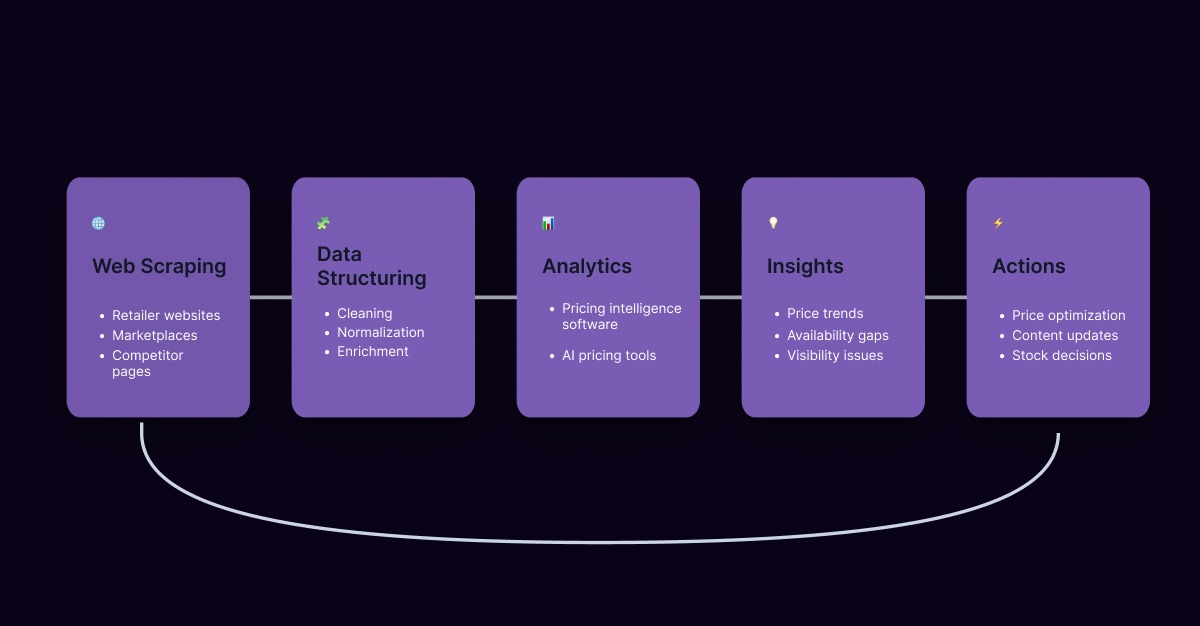
A modern approach to web scraping for digital shelf analytics includes several key steps:
1. Data Collection with Web Scraping
Automated web scraping tools extract data from multiple ecommerce sources.
2. Data Structuring
Collected data is cleaned and standardized for analysis.
3. Data Analysis
Pricing intelligence software and analytics tools process the data to identify trends.
4. Insight Generation
Teams receive actionable insights based on web-scraped data.
5. Continuous Monitoring
Web scraping runs continuously to provide real-time updates.
Common Challenges in Digital Shelf Data Collection
Product matching across retailers
The same product often appears with different names, formats, or descriptions, making comparisons difficult.
Inconsistent data formats
Data collected from multiple sources requires cleaning and standardization before analysis.
Frequent website changes
Retailers update layouts and structures regularly, which can disrupt data collection.
Scaling across large catalogs
Tracking thousands of products across regions increases complexity quickly.
Separating signal from noise
Constant price and content changes make it harder to identify meaningful insights.
How Modern Web Scraping Tools Address These Challenges
Dynamic websites
Modern scraping tools adapt to frequent changes in ecommerce site structures.
Data scale
Scalable platforms manage large datasets across thousands of products and multiple retailers.
Data accuracy
Reliable systems validate and standardize data to support consistent analysis.
Multi-region tracking
Web scraping enables monitoring across different countries and marketplaces.
How Platforms Like Import.io Support Web Scraping at Scale
Most web scraping solutions focus on collecting data. The real challenge is making that data usable.
Differences in product naming, inconsistent formats, and changing website structures create gaps that affect accuracy.
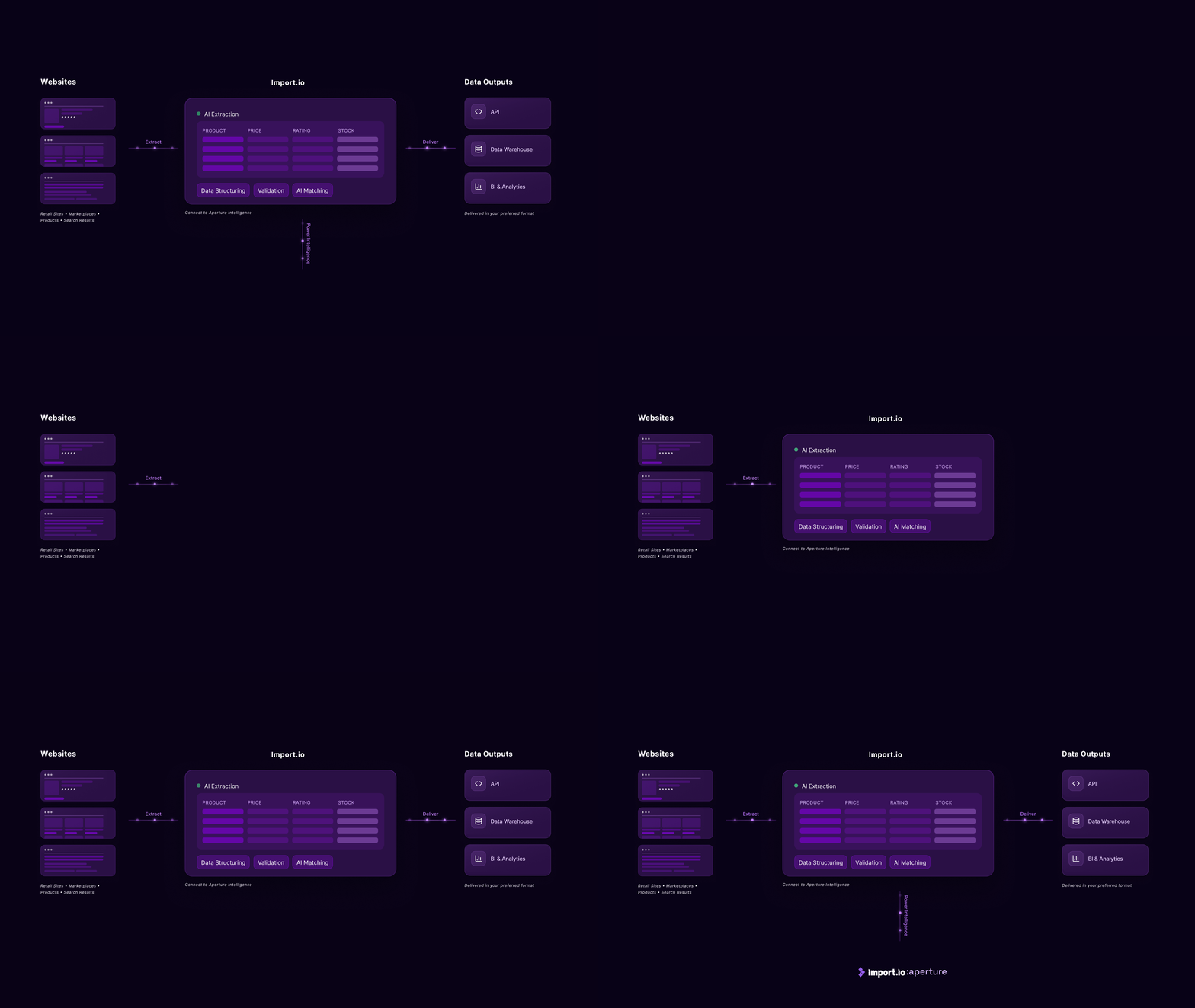
Import.io addresses this by structuring and normalizing web data, allowing teams to work with consistent, analysis-ready datasets across retailers and markets.
With platforms like Import.io Aperture, teams can:
- Extract data from multiple ecommerce sites at scale
- Automatically structure and normalize raw web data
- Ensure consistency across products, categories, and retailers
- Integrate data directly into digital shelf analytics workflows
- Support pricing intelligence and AI-driven analysis with clean datasets
Web scraping is only the first step. The real value comes from transforming unstructured web data into a format that teams can trust and act on.
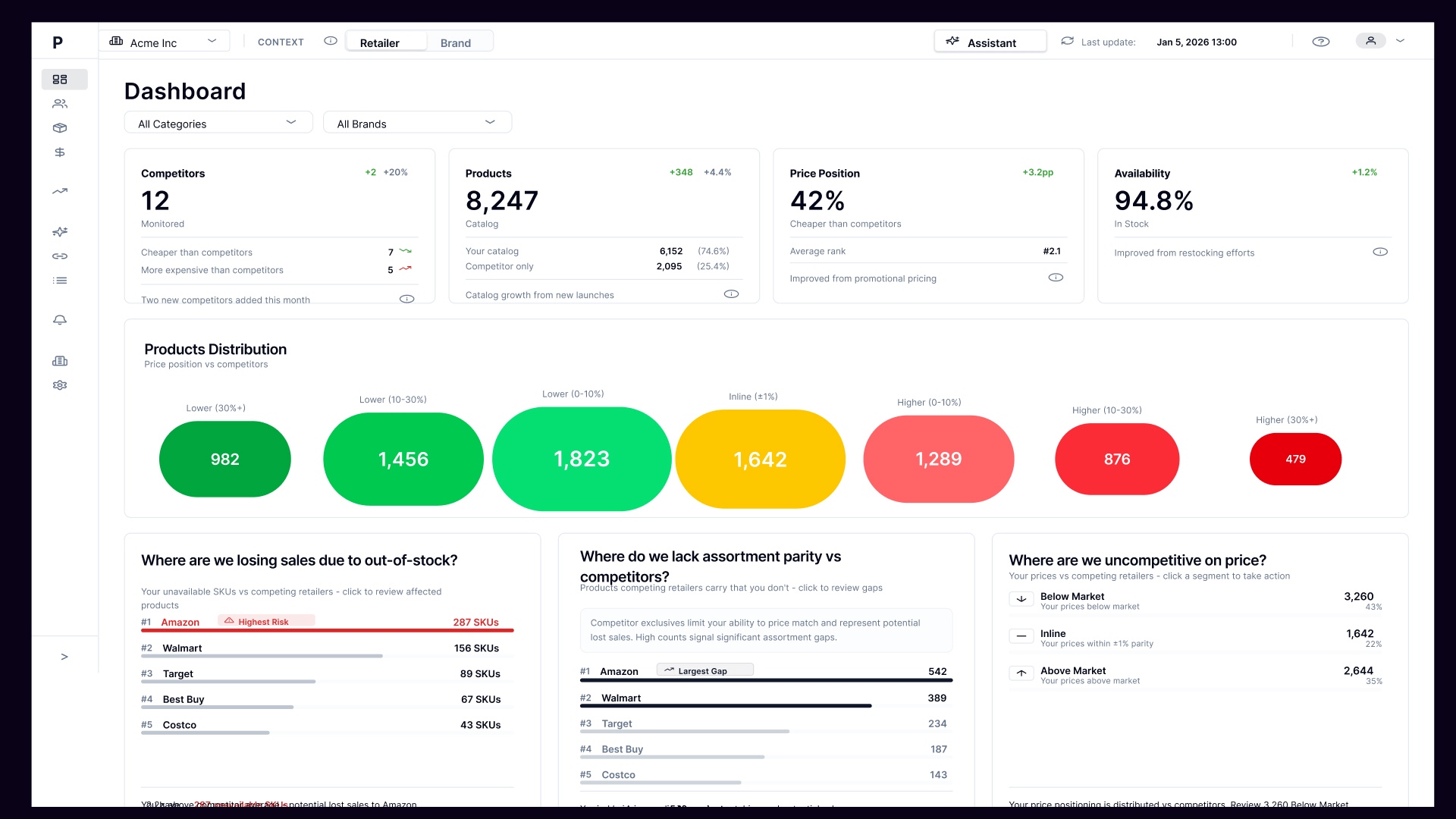
This is where many digital shelf analytics efforts struggle. Data may be available, but without proper structuring and validation, it becomes difficult to use for pricing decisions, competitor monitoring, or performance analysis.
By focusing on data quality, structure, and usability, teams can move beyond data collection and build workflows that support faster, more reliable decision-making. See how structured web data supports digital shelf analytics here.
Benefits of Web Scraping for Digital Shelf Analytics
Web scraping supports digital shelf analytics by improving both data coverage and reliability.
Key benefits include:
- access to real-time pricing and availability data
- consistent tracking across multiple retailers
- reduced manual data collection
- improved product matching and comparison
- better visibility into competitor activity
Why Web Scraping Is a Competitive Advantage
In 2026, web scraping is a critical capability for ecommerce brands.
When combined with:
- Digital shelf analytics
- Pricing intelligence software
- AI pricing tools
- Competitor price monitoring tools
Web scraping enables businesses to:
- React quickly to market changes
- Maintain competitive pricing
- Improve product visibility
- Monitor competitors effectively
- Make data-driven decisions at scale
Why Web Scraping Continues to Matter in 2026
Web scraping plays a central role in digital shelf analytics by providing access to consistent, up-to-date ecommerce data.
When combined with structured data processing and analytics, it enables brands to monitor performance, track competitors, and make faster decisions.
As ecommerce environments continue to evolve, companies that invest in reliable data collection and analysis will be better positioned to adapt and compete.
Recommended Reading
Unlock the Power of Web Scraping as a Service
The Hidden Cost of Web Scraping: Why Data Teams Are Moving to Market Intelligence Platforms
How to Perform a Competitor Analysis using Web Scraping in 2026
