
From Data Noise to Action: How AI Is Changing Pricing and Digital Shelf Intelligence

In today’s ecommerce landscape, companies handle more data than ever before.
Retailers and brands continuously generate information about competitor prices, product listings, stock availability, promotions, and customer behaviour. Managing this volume of data requires tools that can organize, analyze, and deliver insights in a usable format.
This is where AI pricing tools, pricing intelligence software, and advanced digital shelf analytics are reshaping how businesses operate. Platforms like Import.io aperture support this shift by helping teams turn large datasets into structured, actionable intelligence.
The Challenge: Managing Data at Scale
Ecommerce teams depend on accurate and timely data to stay competitive. Pricing teams rely on competitor price monitoring tools, category managers track assortment changes, and analysts evaluate trends across markets.
Common challenges include:
- fragmented datasets across multiple tools
- inconsistent product matching across retailers
- delays in data updates
- manual data preparation
- limited visibility into competitor activity
Without scalable pricing intelligence software, these challenges can slow down analysis and reduce the effectiveness of decision-making.
.avif)
What Is Digital Shelf Intelligence?
Digital shelf intelligence focuses on how products appear and perform across online marketplaces and retailer websites.
This is powered by digital shelf analytics, which provide visibility into:
- product pricing
- stock availability
- promotions and discounts
- product rankings and visibility
- competitor assortment
Digital shelf analytics allow businesses to monitor their market position and understand competitor activity across channels.
Moving From Data Collection to Insight
Collecting data is an important step, but structured analysis is what supports decision-making.
Traditional workflows often include:
- collecting data through scraping or integrations
- cleaning and structuring datasets
- matching products across retailers
- analyzing trends manually
- sharing insights across teams
Modern AI pricing tools streamline this process by automating data structuring, product matching, and monitoring.
How AI Supports Pricing Intelligence
AI introduces automation and scalability into pricing workflows, making it easier to manage large datasets and generate insights.
Automated Data Structuring
Pricing intelligence software uses AI to convert unstructured web data into standardized datasets. This improves data quality and reduces the need for manual preparation.
Product Matching Across Retailers
AI enables accurate product matching across different websites, even when product names or formats vary. This supports more reliable comparisons within competitor price monitoring tools.
Continuous Monitoring and Updates
AI-powered systems continuously track changes in pricing, availability, and promotions. This allows teams to stay informed and adjust strategies using real-time data.
Data Analysis and Pattern Recognition
AI can process large datasets to identify patterns such as:
- pricing trends
- promotion frequency
- stock availability changes
- category-level insights
These capabilities strengthen the role of AI pricing tools in supporting strategic planning.
AI and Digital Shelf Analytics
Digital shelf analytics rely on consistent and comprehensive data across multiple retailers.
AI supports this by:
- monitoring product listings at scale
- structuring data for analysis
- enabling comparisons across competitors
- identifying changes in the digital shelf
This provides a clear view of how products perform across markets and channels.
From Scraping to Scalable Platforms
Many organizations begin with web scraping to collect ecommerce data. As data needs grow, maintaining scraping systems requires ongoing resources and technical effort.
This has led to increased adoption of pricing intelligence software and competitor price monitoring tools designed for scalability and reliability.
These platforms provide:
- structured datasets
- automated monitoring
- consistent data updates
- analytics-ready outputs
How Import.io Aperture Supports AI-Driven Intelligence?
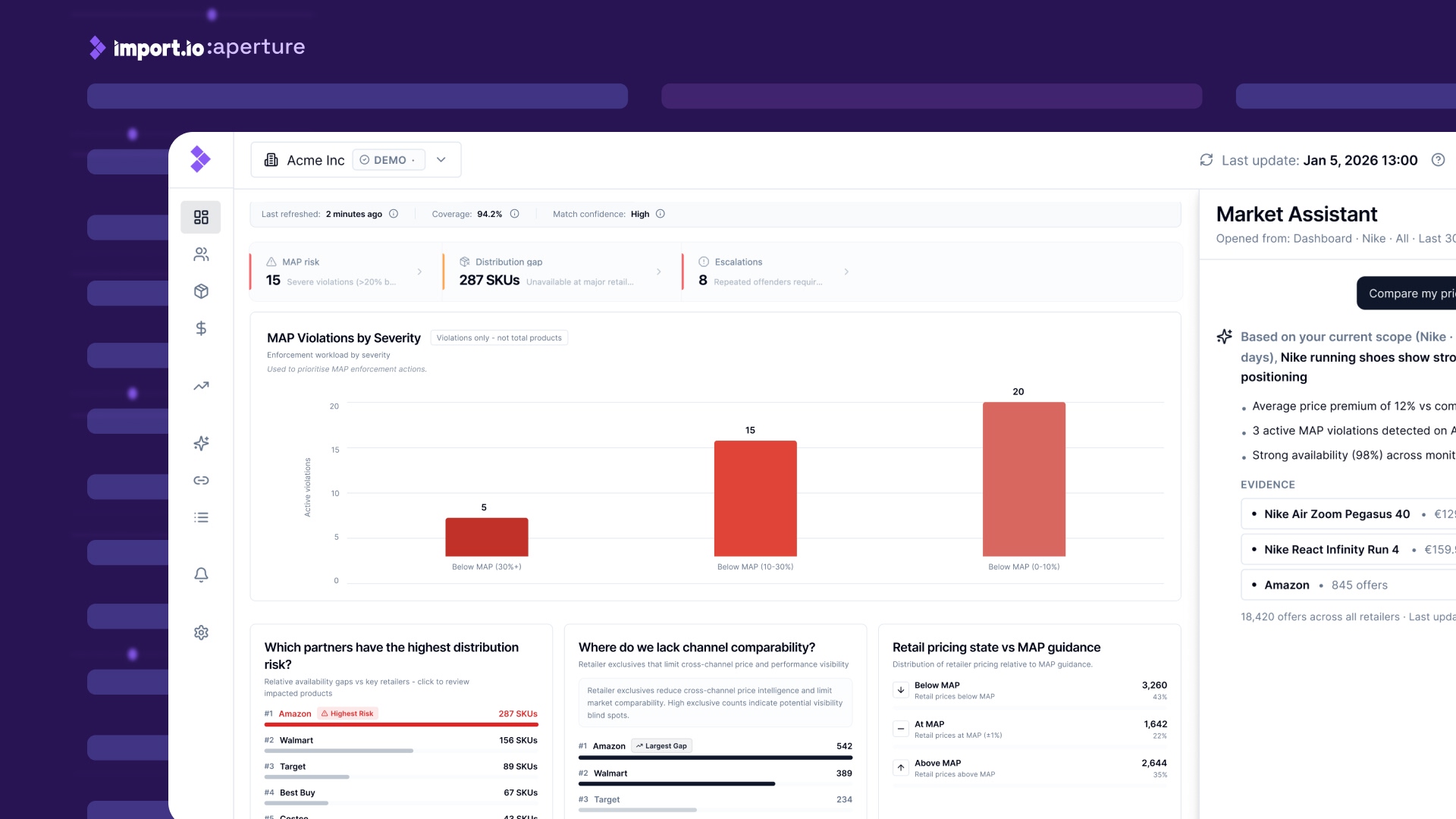
Import.io aperture is a pricing intelligence software platform that supports digital shelf visibility and competitor monitoring.
It provides:
- integrated competitor price monitoring tools
- real-time digital shelf analytics
- automated product matching
- monitoring of stock, promotions, and assortment
- continuously updated datasets
This enables teams to access reliable market data without maintaining custom data pipelines.
Applying Insights in Pricing and Ecommerce
With structured data and AI-supported analysis, businesses can:
- update pricing strategies based on current market data
- monitor competitor activity across channels
- identify assortment gaps
- optimize product positioning
- improve overall performance
AI pricing tools support these workflows by delivering consistent and timely insights.
See AI-Driven Market Intelligence in Action
Access to structured data and analytics can simplify how teams manage pricing and competitor monitoring.
With Import.io aperture, businesses can use pricing intelligence software, digital shelf analytics, and AI pricing tools in a single platform.
Monitor competitor prices, track product availability, analyze assortment changes, and work with real-time data across markets.
Explore the Aperture demo to see how AI-powered competitive intelligence works in practice here.
The Evolving Role of AI in Competitive Intelligence
AI continues to expand how businesses manage and use market data.
Organizations are increasingly adopting:
- automated data collection and structuring
- real-time monitoring systems
- scalable analytics platforms
- integrated competitor price monitoring tools
Platforms like Import.io aperture support these capabilities by combining data access with analytics.
Conclusion
Ecommerce businesses operate in environments where data is constantly changing. Managing this data requires tools that can organize, analyze, and deliver insights efficiently.
Pricing intelligence software, digital shelf analytics, and AI pricing tools provide the foundation for understanding competitor activity and market dynamics.
By using structured data and automated analysis, businesses can maintain visibility across the digital shelf and support more effective pricing and ecommerce strategies.
Use AI to prioritise pricing and shelf signals.
Recommended Reading
Web Scraping for Digital Shelf Analytics: What Brands Need in 2026
What Is the Digital Shelf in 2026 (and Why It Matters More Than Ever)
Why the digital shelf is key for eCommerce analytics providers
