
How Financial Analysts can leverage web data extraction
Originally published in 2017. Updated in May 2026.
How Financial Analysts Can Leverage Web Data Extraction in 2026?
Financial analysts depend on the accuracy and timeliness of the data they work with. When the inputs are slow or incomplete, the conclusions usually are too.
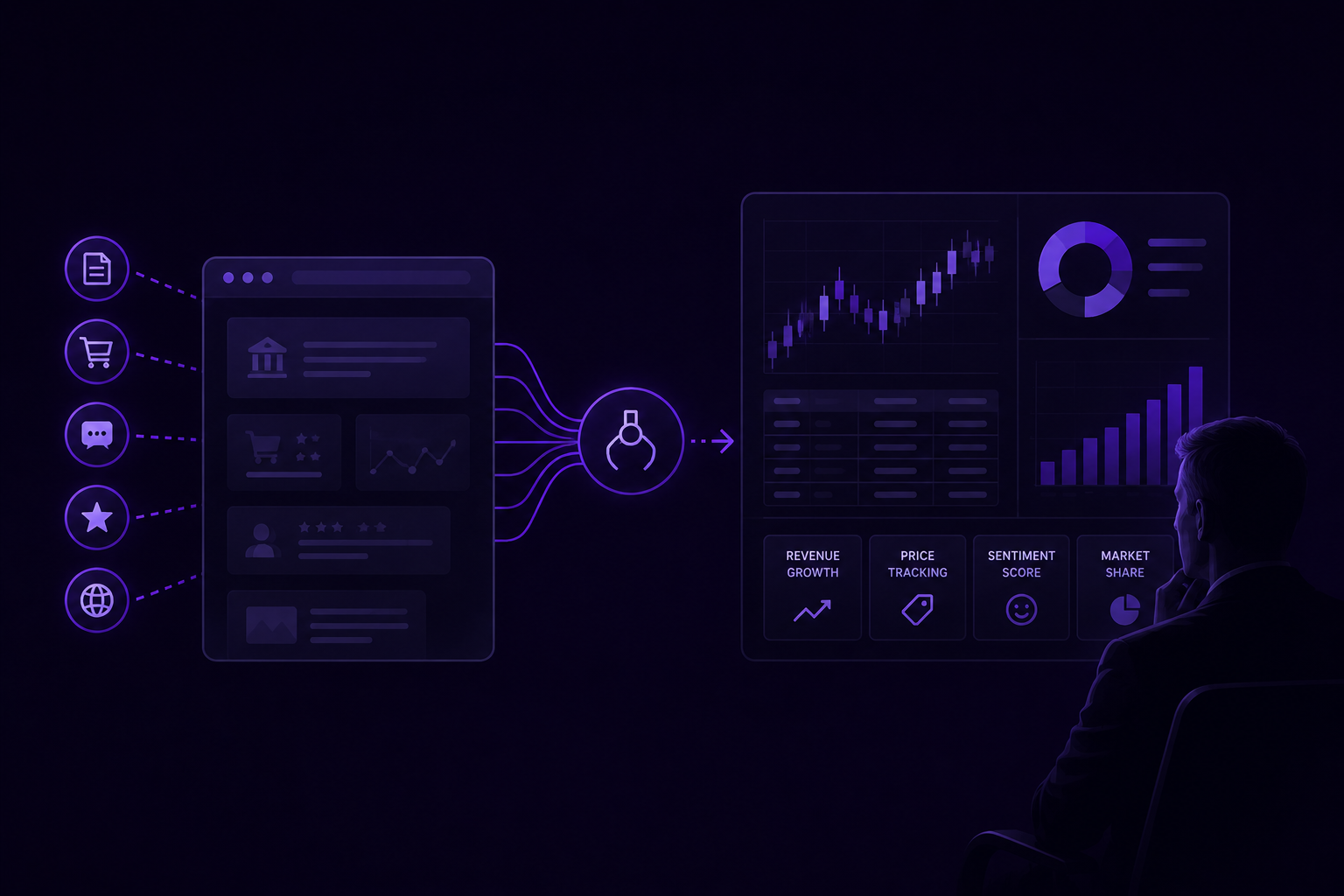
Company filings, earnings calls, and analyst notes still matter, but they only tell part of the story, and they tell it slowly. By the time a 10-Q lands, the market has often already moved on to what was hiding inside it. That is why web data extraction has become a core part of how modern analysts work. Pulling structured information from public web sources and layering AI on top of it gives analysts a faster read on companies, categories, and consumer behavior than traditional reporting cycles allow.
The tooling has matured a lot since the mid-2010s. What used to be brittle scraping scripts and overnight CSV exports is now closer to a managed data operation, with monitoring, validation, and clean delivery into the systems analysts already use.
Here is how financial analysts are putting web data extraction to work in 2026, and where AI and platforms like Import.io Aperture fit in.
Evaluating startups and private companies
Working out how a startup is actually performing still takes a lot of digging. Funding announcements, founder backgrounds, hiring patterns, product launches, customer reviews, app store rankings, and pricing pages are all publicly available, scattered across dozens of sources.
Manually stitching that picture together for a portfolio of companies is slow and inconsistent. Web data extraction gives analysts a structured view of the same signals at scale, so they can compare hiring velocity between one Series B and another, or track how pricing pages change across a category over time. AI-assisted extraction helps here because layouts on sites like Crunchbase, LinkedIn, AngelList, and product directories change constantly. Modern extraction platforms adapt to those changes instead of breaking.
For venture and growth investors, this turns due diligence into something closer to continuous monitoring rather than a one-off research project.
Researching public markets
Public market research is the most obvious use case for web data, and also the easiest to do badly. There is a lot of it, much of it is noisy, and a fair amount is duplicated across sources.
The shift in 2026 is less about gathering more data and more about getting cleaner, decision-ready inputs. Analysts are pulling structured feeds of filings, transcripts, broker pages, retail investor sentiment, and alternative datasets, then using AI to summarize, tag, and surface anomalies. The work moves from collection to interpretation.
Reliable extraction matters here because a missing filing or a misparsed earnings table can quietly distort a model for weeks. This is one of the areas where managed data delivery tends to win against in-house scraping, which often ends up consuming engineering time that was meant for analysis.
Tracking pricing intelligence as a market signal
Pricing has become one of the most useful alternative datasets for analysts covering consumer, retail, ecommerce, travel, and FMCG names. Price movements, promotional cadence, and assortment changes often appear in the data weeks before they appear in reported revenue.
Pricing intelligence as a discipline has grown beyond competitive benchmarking. Analysts now use it to:
- Detect early signs of margin pressure across a category
- Identify promotional aggression from a specific retailer or brand
- Spot stock-outs and availability gaps that hint at supply chain stress
- Compare pricing strategies across regions and channels
This is where Import.io Aperture is a useful alternative to building a pricing collection in-house. It delivers structured pricing, availability, and assortment data across retailers and marketplaces, with the validation and monitoring required for financial-grade analysis. For analysts who care more about the signal than the plumbing, that distinction matters.
Reading social and community signals with AI
Eight years ago, scraping Reddit threads to predict video game sales felt like a novelty. In 2026, social and community data are a standard input for consumer-facing equity research.
What has changed is how analysts process it. Raw comment volume is rarely useful on its own. AI models now classify sentiment, extract themes, cluster product mentions, and separate real consumer signal from coordinated noise. Analysts can track shifts in how a brand is discussed across Reddit, TikTok comments, review platforms, and niche forums, then correlate that with pricing, availability, and search behavior.
The risk is well known. Social data is messy, easy to game, and full of bots. Treating it as one input among several, rather than a standalone thesis, is how good analysts use it.
Mapping competitors, products, and assortment
For analysts covering consumer goods, retail, and ecommerce, understanding what competitors actually sell is harder than it sounds. SKUs change, listings move between marketplaces, and assortment varies by region.
Web data extraction gives analysts a continuous view of product catalogs, pricing tiers, bundle structures, and new launches. Combined with digital shelf analytics, this can answer questions like: Is this brand quietly expanding into private label? Are they losing shelf share on Amazon to a challenger? How fast are they rolling out a new line across regions?
These are the kinds of questions earnings calls rarely answer directly, and where alternative data earns its keep.
Parsing financial statements and filings at scale
Pulling income statements, balance sheets, and cash flow data from public sources is still a common workflow. The difference now is that AI handles much more of the parsing, normalization, and cross-company comparison.
Instead of an analyst manually reconciling line items across a peer group, structured extraction plus AI delivers comparable tables ready for modeling. That frees up time for the harder work: judgment about what the numbers mean.
For analysts who need this at scale across hundreds of tickers, the choice usually comes down to building internal pipelines or working with a managed data partner. Internal builds offer control. Managed delivery offers reliability and lower total cost of ownership, especially when source sites change frequently.
Staying ahead of industry trends
Industry monitoring is often the first thing to slip when analysts get busy. It is also where blind spots tend to form.
Continuous extraction from news sites, regulatory portals, trade publications, job boards, and company blogs, combined with AI summarization, provides analysts with a steady view of what is changing in their sectors without requiring hours of manual reading each week. Done well, it acts less like a news feed and more like a quiet early warning system.
Where Import.io Aperture fits
Most of the use cases above share the same underlying need: clean, reliable, structured external data, delivered consistently, without the analyst having to babysit the pipelines.
Import.io Aperture is built for that. It combines large-scale web data extraction with AI-assisted automation, self-healing pipelines, and enterprise-grade governance. For financial analysts, that translates into pricing, product, availability, and market data that arrives in a usable state, with the audit trails and compliance posture that institutional users expect.
Compared with stitching together open-source scrapers, point tools, and manual QA, a managed approach tends to be faster to deploy, easier to scale across new sources, and less exposed to the operational risk of websites changing overnight.
The point of all of this
The value of web data extraction for financial analysts has not really changed since 2017. It is still about spending less time gathering data and more time interpreting it.
What has changed is the maturity of the tooling and the role of AI in the workflow. Analysts who treat external web data as a core input, not a side project, tend to see things earlier, model them more accurately, and make better calls. The firms supporting them with reliable infrastructure, whether internal or managed, are the ones quietly compounding that advantage.
