
Best MAP Monitoring Software in 2026: Compared
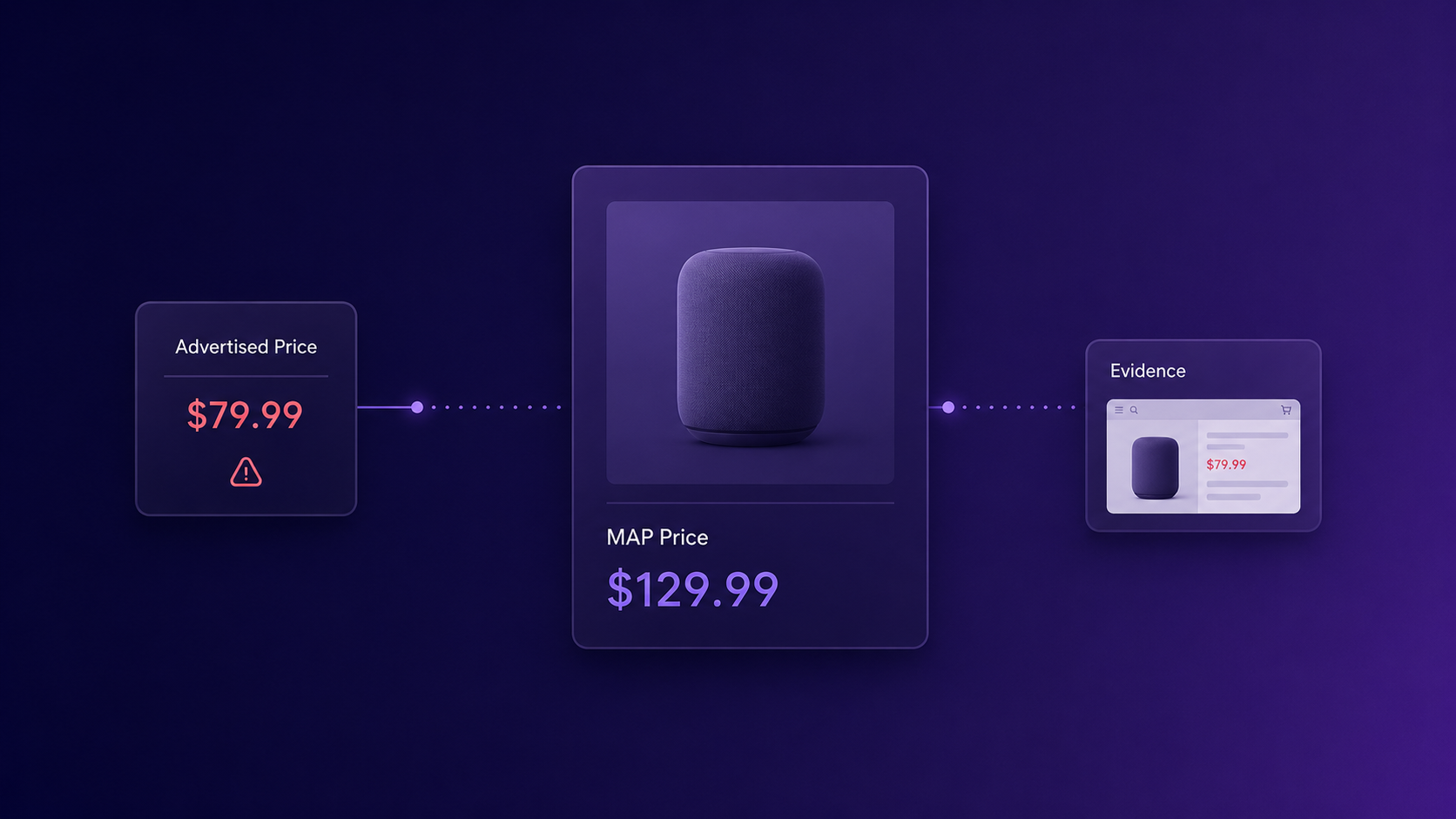
MAP monitoring software tracks the advertised prices of your products across retailers and marketplaces, detects when a listing falls below a brand's Minimum Advertised Price, and supports enforcement. The strongest tools go further, adding evidence capture, product matching, and workflow integration so channel teams can act on what they find.
The right tool depends on what you need it to do. Some brands want broad monitoring, others want deep analytics, turnkey legal enforcement, or legal-grade evidence, and your catalogue size and retailer count shape the decision too. Below are the leading tools grouped by what each one does best.
Learn more about automated MAP enforcement workflows and MAP compliance across the US, EU and UK.
End-to-end MAP management with evidence-grade data: Import.io Aperture
Aperture runs the whole in-house MAP workflow in one place, from setting reference prices through violation detection, evidence review, retailer follow-up, and data delivery. You set and maintain MAP prices per product, with effective dates, optional expiry, active or inactive status, and source tracking for manual updates, CSV imports, or configured integrations. Coverage views show which products have active MAP prices and which still need setup before you rely on detection, and bulk management handles CSV uploads with validation and a review-before-apply step, so prices are never ended by accident.
Detection prioritises violations by how far below MAP a retailer has gone, and every violation is backed by timestamped observations, captured pages and screenshots where available, offer URLs, merchant metadata, and historical captures. AI-assisted product matching connects rules to the right products across multi-variant SKUs and inconsistent listings, teams can send product-level follow-up messages to retailers using the violation context, and that history stays tied to the product for audit. Normalised MAP and pricing data can be reviewed in dashboards or delivered downstream through feeds, files, or API.
Aperture suits brands and channel teams that want to run MAP monitoring and compliance in-house, especially where retailer coverage, custom data sources, international markets, and repeatable follow-up matter. Its honest limitation: it works better as a data, monitoring, and workflow layer than as a fully outsourced legal-enforcement service. Teams that want enforcement letters and managed legal-style outreach handled for them may also look at dedicated enforcement platforms.
Overall for turnkey MAP enforcement: TrackStreet
TrackStreet combines monitoring, evidence capture, automated violation notices, escalation rules, and Do-Not-Sell lists into a managed enforcement operation. Its engine evaluates crawled prices against your rules across more than 185,000 websites and marketplaces, then places merchants into the right enforcement sequence, with notices sent automatically or reviewed first, at the merchant, product, or style level. Pricing is custom. Best for established brands with large reseller networks that want an outsourced enforcement operation rather than a data feed to act on themselves.
For large enterprise brands: Wiser
Wiser treats MAP compliance as one pillar of a broader retail-intelligence program that also spans price execution, digital shelf, and in-store execution. It detects below-MAP listings, sends automated strike notices, and reports compliance live, and it pairs online monitoring with a crowdsourced in-store audit network for full-circle visibility across digital and physical shelves. Pricing is enterprise and custom. Best for enterprises that want MAP inside a wider pricing and retail-intelligence stack, and that need both online and in-store coverage.
Seller intelligence and digital shelf, with enforcement built in: Wayvia (formerly PriceSpider)
PriceSpider completed its rebrand to Wayvia in mid-2025, and in late 2025 it relaunched its MAP product, Prowl, as a closed-loop system that pairs monitoring with proactive enforcement. Prowl covers real-time violation detection, unauthorised-seller identification, bulk violation notices, and a rebuilt capture system for proof of violations, alongside the "where to buy" and seller-intelligence features the company built its name on. Because MAP sits inside a broad ecommerce data platform, buyers who only need MAP should price the Prowl module on its own. Best for large consumer brands that want MAP and seller intelligence together, particularly across multi-seller marketplaces such as Amazon, Walmart, and eBay.
Flexible, value option: Price2Spy
Price2Spy covers marketplaces, product variations, instant alerts, historical reports, and international currencies, with price checks up to eight times a day. It publishes its entry pricing, with Basic plans starting around $157.95 a month and Premium moving to a custom quote, while screenshot evidence, automatch, and repricing are priced as separate add-ons. Enforcement is customer-led, so Price2Spy supplies the data, alerts, and screenshot evidence while contacting sellers stays with your team. Best for small-to-mid brands that need reliable monitoring on a known budget, and well suited to multi-seller marketplace channels.
Transparent pricing and simple setup: Prisync
Prisync gives brands reseller-price visibility with published, transparent pricing and fast setup, running roughly from $99 to $799 a month depending on the monitoring model and tier. MAP monitoring is included in its plans and flags which resellers are advertising below your minimum, with violation reporting to support follow-up. Evidence is report-based rather than a dedicated screenshot module. Best for small-to-mid brands where price visibility matters more than a full legal-enforcement operation.
How to choose MAP monitoring software
Start with evidence. Buyers consistently rank evidence collection as the single most important capability, because timestamped screenshots and audit trails are what make a violation defensible when you take it to a retailer. From there, look at first-party marketplace tracking, so you can see behind the buy box on Amazon and Walmart where unauthorised sellers most often break MAP. Check that the tool supports graduated enforcement workflows rather than only surfacing violations, and confirm its product matching holds up across inconsistent, multi-variant listings. Finally, weigh integration, since API or feed delivery into your CRM, BI, or compliance systems is what turns monitoring into action.
Where Import.io Aperture fits
Aperture supports the complete MAP workflow in one place. You set reference prices, track coverage, detect and prioritise violations by severity, review timestamped retailer observations and captured evidence where available, match products across awkward listings, alert your team, create product-level retailer follow-up messages, and keep controlled, review-before-apply change history, all built on data extraction that handles difficult and custom sources. It is strongest when you want to run MAP compliance in-house with supporting evidence, rather than outsourcing enforcement to a managed legal service. If you want the mechanics of that collection, our overview of web scraping techniques goes deeper, and our guide to US, EU, and UK compliance shows what you can and cannot enforce by region.
