
MAP Compliance Across the US, EU, and UK: What's Legal, What's Not, and How to Monitor It
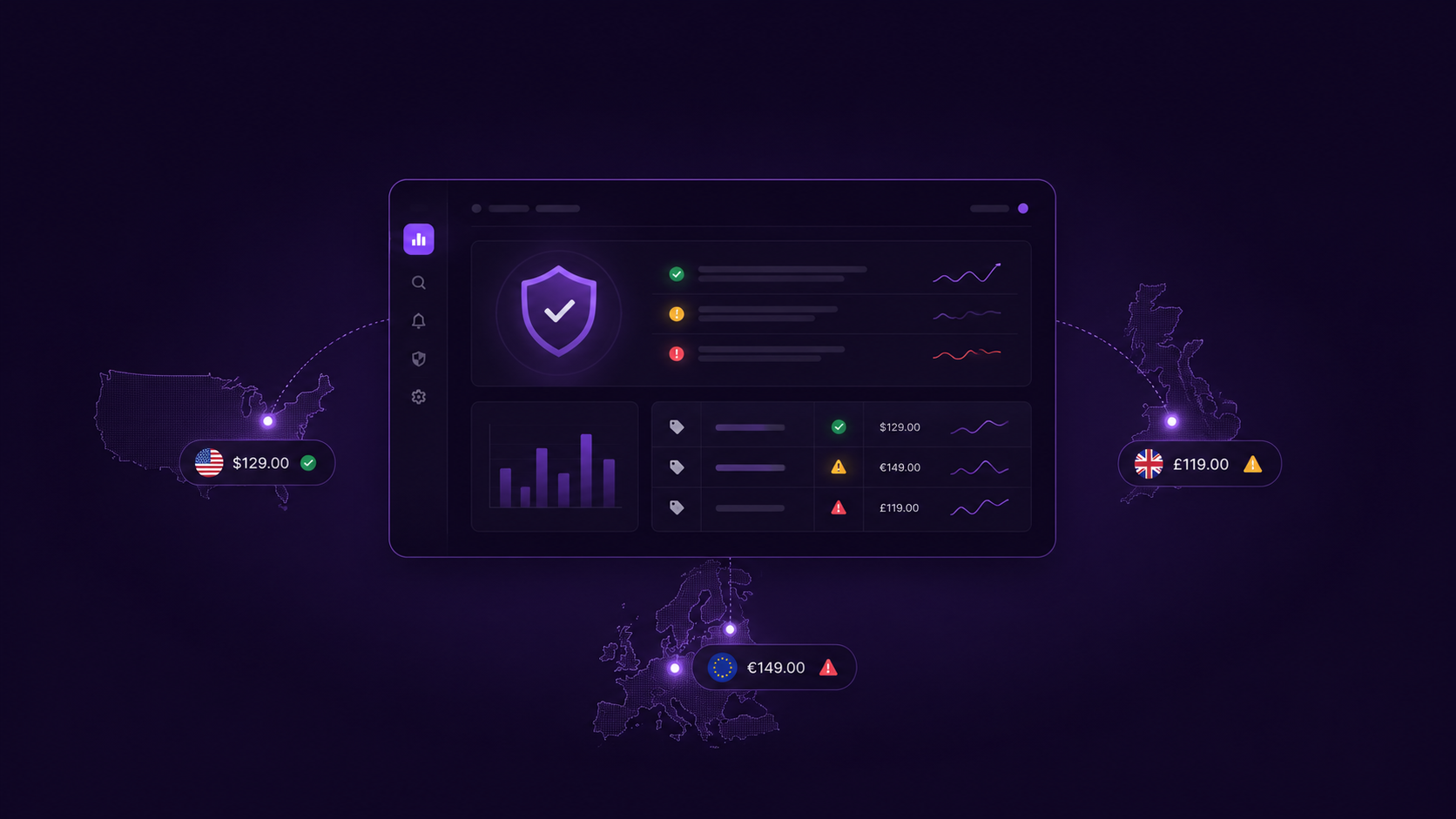
Building a premium brand takes years of relentless focus on quality, product design, and positioning. Yet, in the digital retail ecosystem, that hard-earned value can erode in mere days. Every brand executive knows the frustration of watching their products get aggressively discounted across the web, squeezed by shrinking margins, and facing tense conversations with traditional retail partners.
When trying to track whether retailers are breaking pricing guidelines, many brands fall into a common trap: treating global price monitoring like a one-size-fits-all policing operation.
Depending on where you operate, the legal framework governing Minimum Advertised Price (MAP) enforcement changes drastically. To effectively protect your brand equity without running afoul of international competition laws, you need to understand regional compliance dynamics, and deploy the right data layer to monitor it all.
For a side-by-side comparison of the tools, see our guide to the best MAP monitoring software in 2026.
Want to know more about MAP monitoring?
Talk to our team about tracking retailer compliance across the US, EU and UK
Contact us about Aperture.
The Legal Matrix: US Policy vs. EU/UK Regulations
How you act on pricing data depends heavily on geography:
- In the US Market: Brands can legally institute a unilateral Minimum Advertised Price (MAP) policy. If a retailer advertises below that threshold, the brand can decline to keep supplying that retailer without breaching antitrust law, as long as the policy stays unilateral rather than a negotiated agreement to hold prices.
- In the EU and UK Markets: Any attempt by a manufacturer to dictate or restrict a retailer’s resale pricing crosses the line into Resale Price Maintenance (RPM): a "hardcore restriction of competition" under VBER (Vertical Block Exemption Regulation) and UK competition law. Regulators do not differentiate between advertising a price and selling at a price; retailers must remain free to set their own numbers.
THE UNIVERSAL MONITORING BRIDGE: Real-time pricing data and violation detection are legal, valuable, and necessary EVERYWHERE.
The Universal Rule: While enforcement mechanics differ by region, data collection and market visibility are 100% legal everywhere. You cannot fix what you cannot see. Whether issuing a formal MAP violation notice in New York or diagnosing a supply chain leak in London, success requires an objective paper trail.
The Algorithmic Trap: Price Originators vs. Auto-Matchers
When an online retailer slashes the price of your product, the root cause is almost always automated. Today’s digital landscape is governed by dynamic pricing engines and web scrapers. A single aggressive discount by one online seller can trigger an instantaneous, cascading "race to the bottom" across the internet within minutes.
Without deep, real-time market visibility, brands operate completely in the dark.
If you see ten major retailers all selling your product at 30% below your Recommended Retail Price (RRP), it looks like systemic defiance. In reality, nine of those retailers are simply auto-matching the price. The seller to focus on is the single price originator that started the slide, since the rest are only reacting to it.
This is where automated violation detection becomes critical. To solve price degradation, your monitoring tool must capture precise timestamps to separate the original price-cutter from the reactive bots.
How Import.io Aperture Delivers Compliance-Safe Visibility
To navigate complex global markets, brands need monitoring that behaves like a market radar, with the coverage, history, and timing that basic scraping does not provide on its own. Import.io Aperture provides the advanced data layer required to monitor, detect, and resolve price compliance issues globally.
Aperture transforms raw market data into actionable intelligence by offering:
- Automated Violation Detection: Instantly spot when, where, and by how much a retailer deviates from your MAP or RRP guidelines.
- Timestamped Evidence Chains: Capture exact historical data and screenshots, allowing you to isolate the true price originator from automated price-matchers.
- Global Multi-Region Tracking: Monitor retail compliance across the US, EU, UK, and APAC from a single dashboard, tailoring your response according to local legal frameworks.
By leveraging Aperture, brands transition from reactive, manual "whack-a-mole" checking to proactive, data-driven brand protection.
Actionable Strategies: Resolving Price Disruption Legally
Once Import.io Aperture identifies the specific disruptors originating the discounts, you can deploy targeted strategies tailored to your region.
1. For US Markets: Streamlined Enforcement
With Aperture’s automated violation tracking, US brand protection teams can instantly issue automated compliance notices, log repeated offenses, and enforce policy consequences (such as revoking promotional funds or pausing shipments) with bulletproof data backing.
2. For EU & UK Markets: Diagnostic & Structural Solutions
In regions where direct price dictation is illegal, Aperture’s data acts as a diagnostic asset to execute compliant commercial strategies:
- Identify Gray-Market Leaks: If a minor storefront is running massive discounts, they are likely sourcing inventory from an authorized distributor dumping overstock. Use Aperture’s data to trace volume discrepancies and choke off unauthorized supply.
- Tighten Selective Distribution Systems (SDS): Restrict sales to partners who meet strict qualitative criteria (e.g., premium site design, customer service standards). If a price-originator fails operational benchmarks, you can legally terminate the relationship.
- Leverage Dual Pricing (VBER): Offer different wholesale pricing tiers for brick-and-mortar storefronts versus purely online operations to support physical retailers holding your RRP naturally.
- Collaborative Partner Reviews: Show the originator the Aperture timeline data. Demonstrate how their initial price cut forced competitors to auto-match, neutralizing their volume gains while destroying profit margins for everyone.
From reactive policing to strategic brand protection
Protecting brand equity in 2026 depends on clear visibility across your global distribution network and the ability to act within each local legal framework. Reactive, manual spot-checking rarely delivers that on its own.
Whether you need automated MAP violation enforcement in North America or compliance-safe distribution insights across Europe, Import.io Aperture delivers the real-time visibility you need to protect your margins and preserve your brand value.
Take Control of Your Online Pricing Strategy
Want to see who is originating price cuts across your distribution network?
Schedule a demo of Import.io Aperture today and get complete visibility into your global retail compliance.
This article is general information and not legal advice. Competition and antitrust rules vary by jurisdiction and change over time. Confirm your approach with qualified legal counsel before setting or enforcing a pricing policy.
