
How Enterprises Get Model-Ready Web Data for AI: Training Data, RAG, and Fine-Tuning in 2026
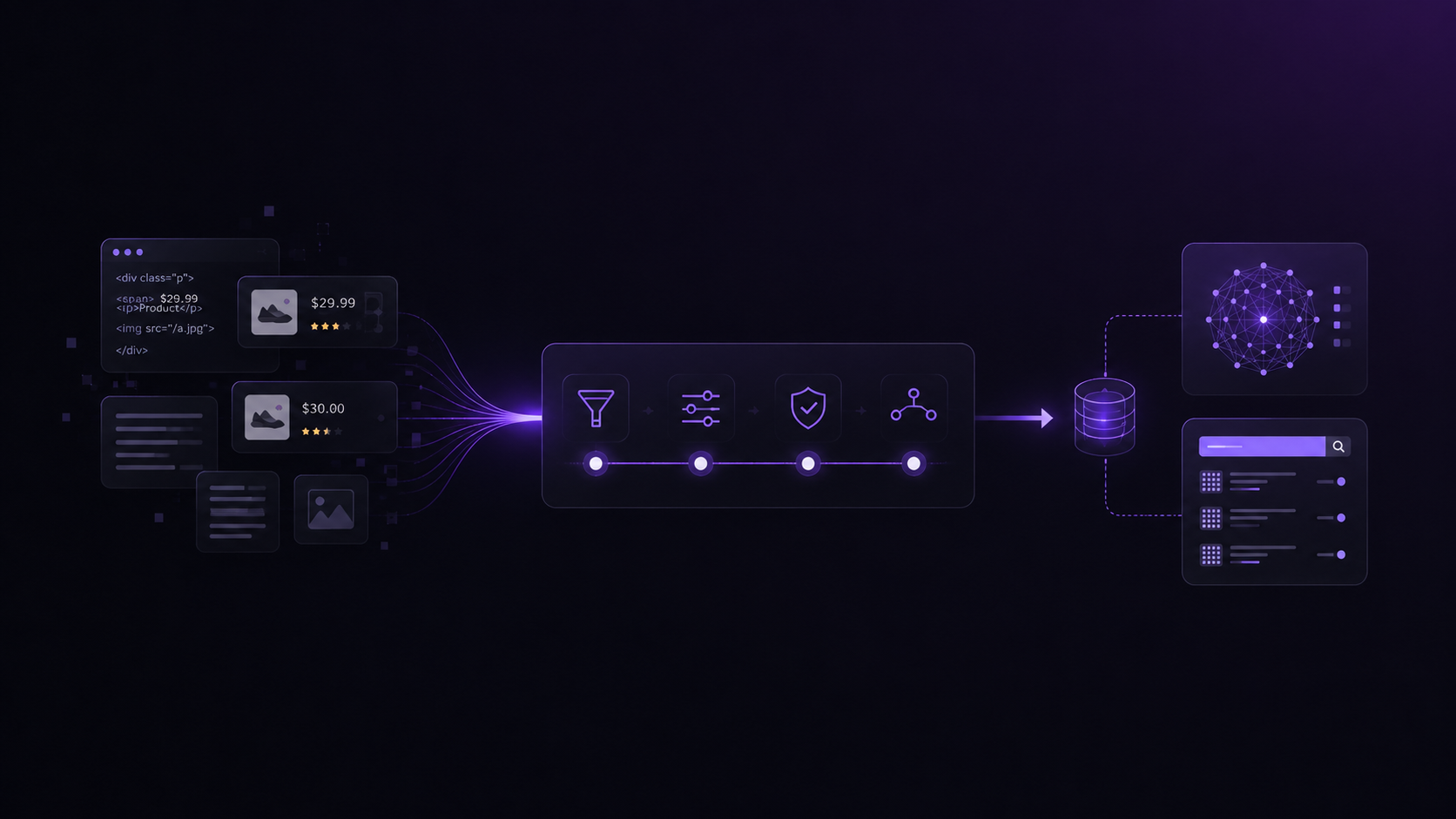
Every AI team eventually hits the same wall. The model architecture is sorted, the compute is budgeted, the use case is clear, and then the data turns out to be the hard part. The trouble is rarely the volume. It is the state of the data. Raw web data is messy, inconsistent, and rarely safe to drop straight into a training pipeline or a retrieval system.
"Model-ready" web data is the missing standard between scraping a website and actually improving a model. This is what it means, why raw extraction falls short, and how enterprises get web data that's clean enough to train on, ground answers with, and defend to a compliance team.
What does "model-ready" web data actually mean?
Model-ready data is web data that has already done the work an AI pipeline would otherwise have to do itself. In practice, that means it is:
- Structured. Organised into consistent fields and schemas rather than raw HTML or free text.
- Deduplicated and normalised. The same entity looks the same everywhere, with consistent formats for prices, dates, identifiers, and units.
- Validated. Checked against source context so obviously wrong captures, such as a monthly payment mistaken for a full price or a placeholder value, are caught before they reach the model.
- Documented. Carrying provenance, timestamps, and a clear record of where each field came from.
- Compliance-checked. With personally identifiable information (PII) detected and handled, and a record that supports GDPR and CCPA obligations.
Raw scraped data has none of these by default. Model-ready data has all of them before it reaches your team.
What do teams actually use web data for in AI workflows?
Three uses dominate, and each has different requirements.
Fine-tuning large language models. Teams use domain-specific web data, such as product catalogues, technical documentation, and industry content, to adapt a general model to a specialised task. Fine-tuning is sensitive to noise. Inconsistent or duplicated examples waste tokens and can actively degrade the model, so clean, deduplicated data matters more here than raw volume.
Powering retrieval-augmented generation (RAG). RAG systems retrieve relevant documents at query time to ground a model's answers in current, factual information. The quality of a RAG system is capped by the quality of what it retrieves. Structured, well-normalised web data with reliable metadata produces grounded answers, while messy data produces confident-sounding errors.
Building training and evaluation datasets. Beyond fine-tuning, teams need representative datasets to train custom models and benchmark performance. These need consistent labelling, clear structure, and enough documentation that results are reproducible.
All three break down the same way when the underlying data isn't model-ready.
Why raw scraping isn't model-ready
There's a meaningful gap between "we scraped the data" and "the data is ready for our model," and it's where most AI data projects lose time.
Pipelines break. Websites change constantly. A scraper that worked last month silently returns empty fields or malformed data this month, and unless someone is watching, that bad data flows straight into your pipeline.
Schema drifts. Different sources structure the same information differently. Without normalisation, the same product or the same field arrives in a dozen incompatible shapes, and the model can't tell they're related.
Governance is an afterthought. Raw scrapes can contain personal data, and using ungoverned data to train models creates real regulatory exposure. Retrofitting compliance after the fact is far harder than building it in.
No one can trace it. When a model produces a strange output, teams need to trace it back to the data. Raw scrapes rarely carry the provenance to make that possible.
Each of these is solvable. The work of solving them is the actual project, and it repeats every time a source changes.
How to get model-ready web data at scale
Getting from raw web data to model-ready data reliably, across many sources, comes down to a few capabilities working together.
Resilient extraction. Self-healing pipelines that detect when a site changes and re-map fields automatically, so the flow of data doesn't silently break. This is the difference between a dataset that stays current and one that quietly rots.
Entity and product matching. AI-driven product matching that recognises when different sources are describing the same thing, so data can be deduplicated and unified rather than arriving as fragments.
Normalisation and validation. Consistent schemas, standardised formats, and validation against source context, so what reaches the model is analysis-ready rather than raw.
A governance layer. Automatic PII detection and removal, configurable sensitivity thresholds, and audit trails, so the data is defensible before it's ever used.
Enterprises generally get here in one of two ways: building and maintaining this pipeline in-house, or using a managed web data service that delivers model-ready data directly. The in-house route offers maximum control. The managed route removes the ongoing maintenance burden, which at scale, across many sources and markets, is where most of the cost and fragility lives.
Governance and compliance for AI training data
This is the part teams underestimate, and it's worth its own section.
Using web data to train or ground AI models raises real questions. Does the data contain personal information? Is its use compliant with GDPR, CCPA, and the terms it was collected under? Can you demonstrate that compliance if asked?
Model-ready data answers these before delivery. PII is detected and masked at extraction. Sensitivity thresholds are configurable to your risk posture. Every extraction carries an audit trail. Reducing legal exposure matters, and there is a bigger payoff too. When web data is structured and governed, you can put it into production with confidence instead of having your legal team block it at the last step.
For AI teams, this is increasingly the deciding factor. The model doesn't care whether the data was governed. Your compliance team, your customers, and your regulator do.
Import.io delivers structured, governed web data for AI and analytics workflows. Explore managed data services or start a free trial of the self-service extraction platform.
