
Big Data Tools for External Web Data: What Enterprise Teams Use in 2026
Originally posted in 2015. Last updated in 2026.
The category called "big data" looks different in 2026 than it did even a few years ago. Volumes have grown, the architecture has gone cloud-native, AI assistance is in every layer, and businesses expect insights in minutes rather than months. One thing hasn't changed: there is no single best big data tool. The right answer depends on which tools fit your team's skills and which fit the specific problem you're solving.
The modern data stack is modular. Teams assemble it layer by layer, picking the best option for each job and connecting them through standard formats and APIs. This guide walks through the layers, names the tools that matter most in each one, and is honest about which legacy tools are still worth knowing and which are largely historical.
The modern data stack at a glance
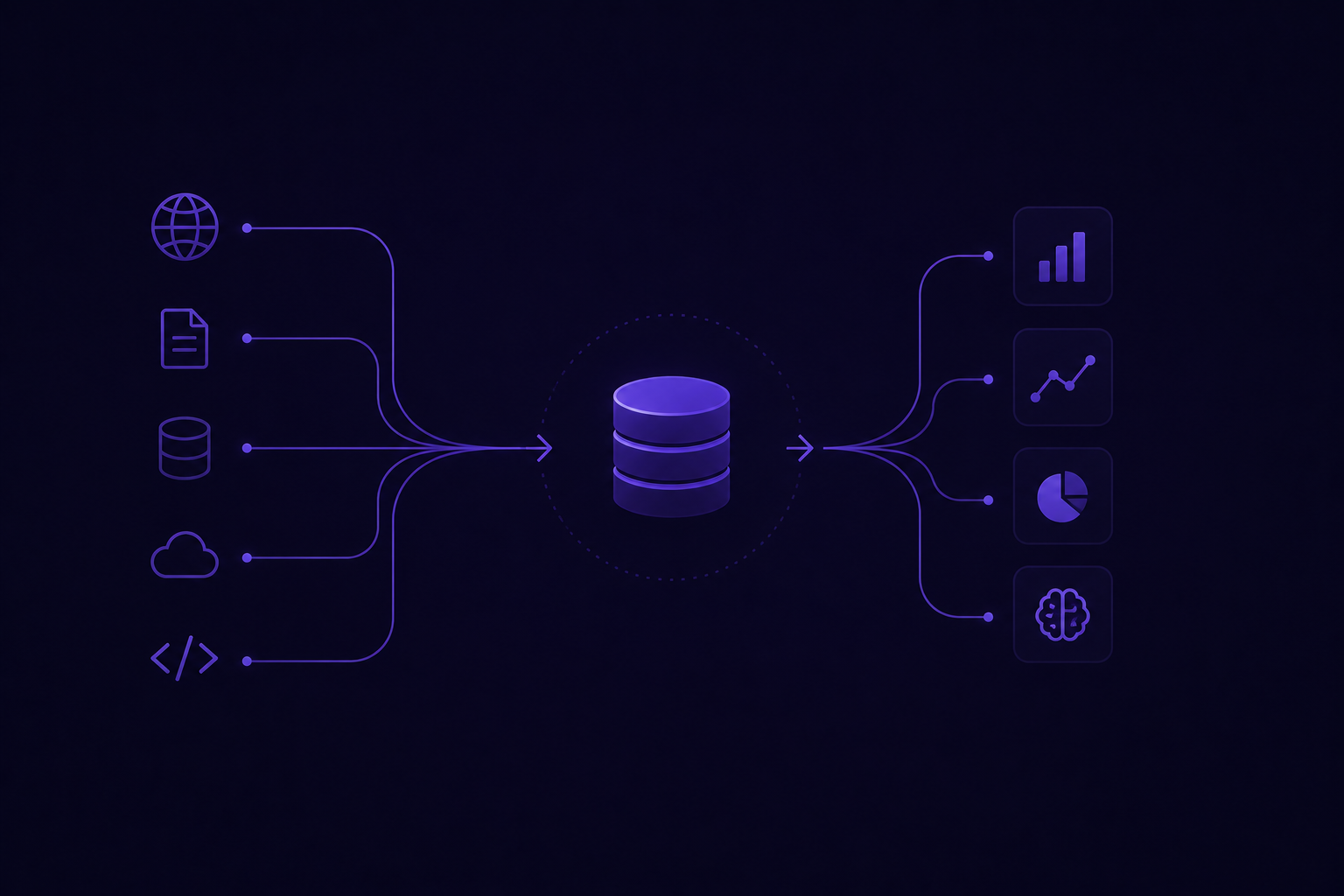
A typical 2026 data stack covers these layers:
- Data collection and extraction - pulling raw data from websites, APIs, apps, and sensors
- Cloud data warehouses and lakehouses - the storage and compute backbone
- Data ingestion (ELT) - moving data into the warehouse on a schedule
- Data transformation - modelling raw data into analysis-ready tables
- Data orchestration - scheduling and managing pipelines
- Streaming and real-time processing handling event data as it arrives
- Data analysis and BI - answering business questions
- Data observability and governance - keeping data trustworthy
- Vector databases and the AI data layer - powering retrieval for AI applications
- Machine learning and data science - building predictive models
- Data languages - the coding foundations that tie everything together
Data collection and extraction
Before any of the rest of the stack matters, you need data. Most internal data already lives in your systems. The harder challenge is external data: competitor pricing, product details, market signals, news, and other information that lives on public websites and isn't available through APIs.
Import.io
Import.io turns websites into structured, machine-readable datasets through a point-and-click interface and a managed service option. It handles authenticated extraction, scheduling, anti-blocking, and delivery into BI tools and data warehouses. Useful for pricing intelligence, digital shelf monitoring, market research, lead generation, and feeding clean web data into ML systems.
Best for: Enterprise teams that need reliable external web data without building scraping infrastructure.
Apache Nutch
Apache Nutch is an open-source web crawler from the Apache foundation. Used by teams with the engineering capacity to run their own scraping stack and willing to handle anti-bot challenges, proxy rotation, and ongoing maintenance.
Best for: Engineering-heavy teams comfortable owning the full extraction pipeline.
Cloud data warehouses and lakehouses
This is the biggest single shift since the early "big data" era. The cluster-on-premise model (Hadoop, HDFS, MapReduce) has been replaced by separated storage and compute running in the cloud.
Snowflake
Snowflake is the default cloud data warehouse for most enterprises starting fresh. Separates storage from compute, scales each independently, and runs across AWS, Azure, and Google Cloud. Strong governance, marketplace, and a mature ecosystem.
Best for: Enterprise warehousing where SQL analytics is the primary workload.
Databricks
Databricks pioneered the lakehouse architecture, which combines data lake economics with warehouse-style performance. Built on Apache Spark, includes Unity Catalog for governance and MLflow for the ML lifecycle. Snowflake vs Databricks is the defining platform decision of 2026.
Best for: Teams running heavy machine learning, streaming, or unstructured data workloads alongside SQL.
Google BigQuery
BigQuery is fully serverless, with no infrastructure to manage and native integration into Vertex AI and the wider Google Cloud stack. Pricing is per-query rather than per-cluster, which suits intermittent workloads.
Best for: Google Cloud-centric organisations and teams that want zero infrastructure management.
Amazon Redshift
Amazon Redshift is the AWS-native warehouse. Strong fit for organisations already deep in the AWS ecosystem, with tight integration into S3, Glue, and SageMaker.
Best for: AWS-centric data teams.
Microsoft Fabric
Microsoft Fabric is Microsoft's unified analytics platform, bundling data engineering, warehousing, BI, and real-time intelligence. Most relevant for organisations standardised on Microsoft and Power BI.
Best for: Microsoft-heavy enterprises looking for one integrated platform.
ClickHouse and DuckDB
Two rising names worth knowing. ClickHouse is an open-source column-store for sub-second analytics on huge datasets. DuckDB is an in-process analytical database that runs locally and is increasingly popular for analyst workflows, with MotherDuck providing a managed cloud version.
Best for: ClickHouse for real-time analytics at scale, DuckDB for fast local analytics on medium-sized data.
Data ingestion (ELT)
Getting data from source systems into the warehouse used to be a custom engineering job. Managed ingestion tools have replaced most of that work.
Fivetran
Fivetran offers managed connectors for hundreds of SaaS sources, databases, and event streams. Sets up in minutes, handles schema changes, and writes directly into your warehouse. Fivetran completed its merger with dbt Labs in mid-2026, combining ingestion and transformation under one vendor.
Best for: Teams that want connectors as a service and predictable pricing.
Airbyte
Airbyte is an open-source alternative to Fivetran with a large connector library and the ability to self-host or use the managed cloud version. More configurable, more engineering effort.
Best for: Teams that want open-source flexibility or have unusual source systems.
dlt
dlt is a code-first Python library for building ingestion pipelines, popular with data engineers who prefer code over configuration.
Best for: Python-native data engineering teams.
Data transformation
dbt
dbt is the reference solution for transforming data inside the warehouse. SQL-based, version-controlled, with built-in testing and documentation. dbt has become the centre of gravity of the modern data stack and is now part of the same company as Fivetran.
Best for: Any team doing SQL transformations in a cloud warehouse, which means most teams in 2026.
Data orchestration
Pipelines need scheduling, dependency management, retries, and monitoring. Orchestrators handle that.
Apache Airflow
Apache Airflow is the most widely used workflow orchestrator. Python-based, mature, with a huge community and integrations into everything.
Best for: Teams that want the industry-standard option with the largest ecosystem.
Dagster
Dagster is a modern alternative built around the concept of data assets rather than tasks. Strong typing, better local development, growing fast.
Best for: Teams starting fresh and wanting a more modern orchestration experience.
Prefect
Prefect is a Python-native orchestrator with a focus on dynamic workflows and a cleaner developer experience than Airflow.
Best for: Python-heavy teams that find Airflow too heavyweight.
Streaming and real-time processing
Some workloads need data the moment it's created, not the next morning.
Apache Kafka
Apache Kafka is the default event streaming platform. Used by most enterprises that move event data at any meaningful scale. Confluent is the main managed offering.
Best for: Event streaming, log aggregation, and real-time data pipelines.
Apache Spark
Apache Spark is a unified engine for batch processing, streaming, and machine learning. Replaced Hadoop MapReduce as the standard processing engine and underpins Databricks.
Best for: Large-scale batch and streaming processing across structured and unstructured data.
Apache Flink
Apache Flink handles low-latency stream processing with strong support for stateful computations and event-time semantics.
Best for: Real-time analytics, fraud detection, and complex event processing.
Storage formats and NoSQL
Apache Iceberg
Apache Iceberg is the dominant open table format in 2026, supported across Snowflake, Databricks, BigQuery, and others. Provides ACID transactions, schema evolution, and time travel on data lake storage.
Best for: Any organisation that wants to keep data in open formats without lock-in.
Delta Lake
Delta Lake is an open table format originally from Databricks. Strong fit for Databricks users, with full Iceberg interoperability now in place.
Best for: Databricks-centric stacks.
MongoDB
MongoDB is the leading document database for semi-structured and unstructured application data. Still widely used for content systems, product catalogues, and real-time applications.
Best for: Operational workloads with flexible schemas.
Data cleaning and preparation
OpenRefine
OpenRefine, formerly Google Refine, is still the most effective tool for interactively cleaning messy datasets, with strong clustering and normalisation features.
Best for: Analysts cleaning unfamiliar or one-off datasets.
dbt tests and Great Expectations
Modern data quality lives inside the pipeline rather than in standalone cleaning tools. dbt has built-in tests for assertions like uniqueness and not-null. Great Expectations is an open-source framework for more comprehensive data validation. For teams collecting web data, applying quality checks at the extraction layer catches issues earlier.
Best for: Teams that want data quality as part of the pipeline, not as an after-the-fact step.
Data analysis and BI
Tableau
Tableau is still a leader in visual analytics, strong for exploratory analysis and executive dashboards.
Best for: Organisation-wide BI with non-technical users.
Power BI
Power BI is Microsoft's BI platform. Often the default for Microsoft-centric organisations and competitive with Tableau on most measures.
Best for: Microsoft-heavy enterprises and teams already in Office 365.
Looker
Looker is Google Cloud's modelling-first BI platform. Strong governance and consistency through its LookML semantic layer.
Best for: Engineering-led teams that want a strict semantic layer.
Datawrapper
Datawrapper is popular with journalists and communications teams for publication-ready charts.
Best for: Storytelling with data, embedded charts in articles.
CARTO
CARTO specialises in location intelligence and spatial analytics.
Best for: Geographic and location-based analysis.
Data observability and governance
A relatively new category that has become essential as data volume grows.
Monte Carlo
Monte Carlo is the named leader in data observability. Uses ML to detect anomalies, freshness issues, and quality problems across the data stack.
Best for: Enterprises that need to catch data quality issues before they reach dashboards.
Atlan, Collibra, DataHub
Data catalogues and governance platforms. Atlan and Collibra are commercial; DataHub and OpenMetadata are the open-source options.
Best for: Documenting data assets, tracking lineage, and supporting compliance.
Vector databases and the AI data layer
This category barely existed two years ago. It's now core to any organisation building AI applications.
Pinecone, Weaviate, Qdrant, Chroma
The four most-cited vector databases in 2026. Used for retrieval-augmented generation (RAG), semantic search, and any AI application that needs to find relevant context fast. Pinecone is the managed leader. Weaviate and Qdrant offer strong open-source options. Chroma is popular for prototyping.
Best for: Any team building AI applications that need to retrieve relevant data for LLMs.
pgvector
pgvector is a Postgres extension that adds vector search to standard Postgres. Often the simplest starting point for teams already using Postgres.
Best for: Teams that want vector search without adding another database.
Machine learning and data science
Hugging Face
Hugging Face is the model hub and ecosystem for open-source ML. Hosts hundreds of thousands of models, datasets, and demos.
Best for: Any team working with open-source models.
MLflow
MLflow is an open-source ML lifecycle platform covering experiment tracking, model registry, and deployment. Included with Databricks.
Best for: Tracking experiments and managing models through to production.
Vertex AI
Vertex AI is Google's managed ML platform, integrated with BigQuery.
Best for: Google Cloud-centric ML workflows.
Kaggle
Kaggle is the largest data science community. Competitions, datasets, learning resources, and a strong recruiting signal.
Best for: Skill-building, finding datasets, and benchmarking models.
Data languages
Even in a no-code environment, understanding the underlying languages gives you leverage.
Python
Python is the dominant data language in 2026. Used for analytics, machine learning, automation, orchestration, and almost everything else.
SQL
Still the universal language of data warehouses and analytics. dbt and modern BI tools have made SQL more central, not less.
R
R is strong for advanced statistics and academic research. Less used in industry than Python but still relevant in specific domains.
Regular expressions and XPath
Foundational for text cleaning and structured web data extraction respectively. Worth knowing even if you mostly work in higher-level tools.
Legacy tools worth knowing about
Several tools that defined the early big data era are still around but rarely chosen for new builds in 2026. Worth understanding for context:
- Apache Hadoop and HDFS: Largely replaced by cloud object storage (S3, GCS, ADLS) and Spark. Still underpins some on-premise enterprise systems.
- Cloudera: Merged with Hortonworks in 2019, now repositioned around cloud and AI but no longer the centre of modern stack conversations.
- Talend: Acquired by Qlik in 2023. Some standalone Talend products have been sunset; the technology lives on inside Qlik's portfolio.
- Pentaho: Now part of Hitachi Vantara. Still used in some enterprise integration projects but rarely a first choice for new stacks.
- Teradata and Oracle: Long-standing enterprise warehouses, increasingly displaced by Snowflake, BigQuery, and Databricks for new projects.
- IBM SPSS Modeler: Still sold for governed enterprise analytics but reads as legacy compared to modern ML platforms.
Building the right stack
A 2026 stack for a typical enterprise data team looks something like this:
- Collection layer: Import.io for web data, Fivetran or Airbyte for SaaS sources
- Warehouse or lakehouse: Snowflake, Databricks, or BigQuery
- Transformation: dbt
- Orchestration: Airflow or Dagster
- Streaming (if needed): Kafka plus Spark or Flink
- BI: Tableau, Power BI, or Looker
- Observability: Monte Carlo or Great Expectations
- AI layer (if building AI applications): Pinecone or Weaviate, plus Hugging Face and MLflow
The exact combination depends on cloud preference, team skill set, and existing investments. The principle holds: invest in clean data first, choose tools that scale with the team, and treat the stack as something you assemble rather than something you buy off the shelf.
If external web data sits anywhere in that picture, Import.io handles the collection layer with managed delivery, monitoring, and structured output that drops cleanly into the rest of the stack. For a deeper look at modern collection methods, see the guide on web scraping techniques.
