
Hiring Data Engineers vs Buying Managed Data: What Enterprise Teams Should Consider in 2026
.jpg)
Originally posted on October 8th, 2015. Updated on May 30th, 2018. New update on December 11th, 2025.
The Data Scientist is one of the most sought after positions in tech – and much of the business world. But the demand is very quickly outstripping the supply.
McKinsey estimates that by 2018, the U.S. economy will have a shortage of 140,000 to 190,000 people with analytical expertise. And if you’re a startup or business that’s looking to expand your data science operations, that might sound a little scary.
Data science is more important today than ever before. A company that doesn’t properly utilize it may end up falling behind the competition. Whole industries are sprouting out of data science, including machine learning and artificial intelligence. Businesses that fail to see the importance of hiring the best data scientists are only doing themselves a disservice. Hiring a data scientist with the right expertise, refined skills, and big ideas to join your team is going to make a big difference in the long run. The big question is how to do it because the competition for data science talent is fierce.
How can you attract top talent in such a competitive market?
We’re not saying it’s going to be easy. After all, a highly qualified data scientist candidate can become a valuable team member, so it’s no wonder that a company would seek hiring one with the right skills. But with these tips from Data Scientist at Insightly, Sara Vera, it’s certainly going to get a lot easier!
In her keynote at Extract SF 2014, Sara gave us her top three tips for hiring great Data Scientists. And now, she’s sharing them with you! Watch the quick 10 minute video of her talk and then read on for a more in depth look at her insights.
How to hire data scientists when demand is higher than supply

Because the field of Data Science is so new, a lot of Data Scientists – like myself – fall into it in a very nonlinear way.
I was originally in a PhD program at the University of Washington, but after I finished my masters degree I decided I didn’t want to stay in academia. I wanted something a little more fast paced. When I started browsing job websites, I realized that my quantitative skill set was pretty valuable in the private sector. I decided to move to San Francisco because I liked how cutting edge the tech industry was and it felt like a great place to deepen my skill set.
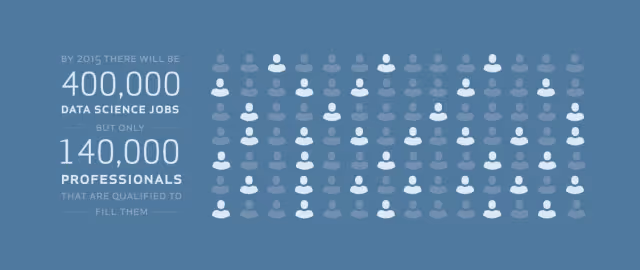
When I got to San Francisco, the demand for Data Scientists was growing fast – way faster than the supply. As a job seeker it’s great. But once I got a job at Insightly and needed to hire more Data Scientists, it became super challenging. I’m going to share with you what worked at Insightly and give you some tips that should help you hire some great people.

Define your needs
Every company has very different needs. It might depend on what industry the company is in or what challenges you anticipate will be waiting for you in the future. Because data science is such a broad field it really helps to first define what you need in your company.
Are you looking for a candidate who is going to be producing data analytics for machines or for humans?
The reason you want to do this is because those are pretty different skill sets, even though they are both done by Data Scientist. For example, if you’re looking to build ad-targeting or recommendation engines or do algorithmic training then you are going to want to look for a candidate with a really strong mathematics and computer science background. You don’t want to bring on a data scientist to your team with a skill set that doesn’t match the needs of your business. That isn’t good for your company, and it isn’t good for potential data science candidates. Hiring a data scientist with top-notch machine learning skills, for example, when your company doesn’t need machine learning skills will not lead to more success.
On the other hand, if you are looking for a data scientist for your company who is going to be reporting to project managers and diving into how the product is doing or how your user growth is going; then you need to find a candidate who’s really good at storytelling. That type of job requires a data science expert who is able to connect what could be pretty fuzzy data points into an overarching narrative of what’s going on in your company. Candidates with these skills are more likely to come from a social science background because in the medical field, sociology, economics, or geography they’re accustomed to doing this with their data.

Hire for talent, train for tech skills
The second thing to do is to hire for data science talent and train for tech skills. This is really important because…
Analytical thinking and communication skills are harder to teach than SQL, Python and R.
I came from an academic background, and while I used data for statistical analysis, I had very little experience doing any kind of coding. Luckily the people who hired me for my first tech job gave me a take home test and I was able to Google all of the coding that I needed to write a beautiful report. Of course when I went in for the on site interview, I completely bombed the technical side of the interview. But they thought I was pretty smart and decided to hire me anyway. And I was able to pick up the SQL and Python through their training and mentorship.
The added benefit of training for tech skills, is that you create an environment where mentorship is really strong, which creates a more cohesive team. The best candidates will want to always be learning from each other anyway.

Broaden your pool of candidates
We have some really strong Data Science candidates here already in the tech world and also graduating from Berkeley and Stanford. But if you look just a little bit deeper than that, or a little bit broader than that, there are a lot of would be Data Scientists at State schools and places like Zipfian and other data boot camps that have popped up. In other words, when hiring for data scientist candidates, it’s important not to get tunnel vision. There are lots of great candidates out there who you might not have ever considered before.
Think outside the box when looking for candidates
The other benefit of this approach, is that if you’re looking in a broader pool of candidates, you’re also going to increase diversity in your company. And by diversity I also mean geography and age, not just gender and race.
Diversity in the workplace is really important because research has shown that it increases your revenue by promoting innovation and creative thinking. Diversity is a huge initiative right now at Google where 100% of managers and 25% of their employee base is going through unconscious bias training.
Hopefully these insights and tips will help you build a great Data Science team!
With machine learning, big data analytics, and artificial intelligence becoming such big components of every business. Following tips ensures the data scientist you hire will become a major contributor to the team. Don’t pass up this opportunity to bring on the best data science talent!
About the author
Sara Vera is a Data Scientist at Insightly, a customer relationship management tool for a small business. It’s a simple, yet powerful, CRM system for small businesses with integrations to Google Apps, Office 365, MailChimp, and major social media sites.
2025 UPDATE: Hiring Data Scientists in the Age of AI, Automation & LLMs
A lot has changed since this article was last updated in 2018, both in the world of data science and in how companies hire, train, and retain technical talent.
Back then, companies were dealing with a shortage of analytically skilled professionals. In 2025, the situation is more complex: some data science skills are oversupplied, while others, especially AI engineering, applied machine learning, and data governance remain critically scarce.
Below is a modernized view of how companies hire data scientists today, what has changed, and what hasn’t.
1. The Data Science Role Has Evolved Dramatically
In 2015–2018, the conversation centered around:
- SQL, Python, R
- statistics & modeling
- analytics vs engineering
- storytelling vs algorithmic thinking

In 2025, the role is shaped by:
AI-native workflows
Data scientists now work alongside:
- Large Language Models (LLMs)
- synthetic data generation
- autonomous agents
- AutoML & automated feature engineering
- AI orchestration tools (LangChain, DSPy, semantic kernels)
Most traditional “data wrangling” is now assisted or performed by AI.
Data scientists are more specialized
Modern sub-roles include:
- AI Engineer / LLM Engineer
- ML Platform Engineer
- AI Product Scientist
- Generative AI Researcher
- Data Governance & Responsible AI Lead
- Analytics Translator / Insights PM
Generalists still exist but specialists are in higher demand.
2. The Talent Gap Still Exists But in New Areas
Original McKinsey projections warned of a huge shortage by 2018.
In 2025, shortages persist, but in different skill categories:
Undersupplied
- AI engineers
- LLM optimization experts
- reinforcement learning specialists
- synthetic data engineers
- data governance, privacy & compliance roles
- real-time data infrastructure engineers

Oversupplied
- junior analysts
- bootcamp-trained generalists
- basic SQL/Python candidates
Companies must now differentiate between commodity skills and strategic skills.
3. The Hiring Advice Still Applies But Needs an Update
Sara Vera’s tips remain shockingly relevant, but here’s how they translate for 2025.
Tip 1: Define Your Needs, Now More Than Ever
In 2025, the key question isn’t just analytics vs machine learning.
It’s also:
- “Do we need a data scientist or an AI engineer?”
- “Is this a human or LLM-assisted analytics workflow?”
- “Is this role more experimentation or more production?”
- “Do we need modeling skills, or orchestration & evaluation skills?”
Examples:
- If you're building personalization, you need ML Ops + AI engineers.
- If you’re doing insights for leadership, you need analytics translators + genAI tooling.
- If you're building a data governance program, you need privacy, quality, lineage experts.
Clear scoping prevents mismatched hires and expensive mistakes.
Tip 2: Hire for Thinking, Train for Tools But Include AI Fluency
Sara’s original advice was timeless:
Analytical thinking and communication skills are harder to teach than SQL, Python or R.

This is still true but now we add:
AI fluency is mandatory.
Data scientists in 2025 must:
- prompt, refine, and evaluate LLMs
- understand hallucination risks
- know how to chain models together
- grasp embeddings, vector databases, and retrieval
- evaluate bias & fairness in AI outputs
These skills can be taught, but you should screen for curiosity, adaptability, and systems thinking not just “can they code?”
Tools like Lovable, Base44, and Storm platforms
mean you are not hiring people to write boilerplate code, you're hiring them to reason about systems.
Tip 3: Broaden Your Pool - Global, Remote, AI-Assisted Talent
The talent pool is no longer Bay Area + Stanford/Berkeley.
In 2025, the strongest candidates often come from:
- global remote markets
- AI engineering bootcamps
- hybrid roles (PMs with AI fluency, engineers who learned statistics)
- research labs that shifted into industry
- open-source AI communities on GitHub & HuggingFace
Diversity is still essential but now includes:
- geographic diversity
- model transparency perspectives
- cross-disciplinary thinking
- ethical, legal, governance viewpoints
The best data science teams combine:
- technical rigor
- storytelling
- ethical foresight
- operational execution
No single “profile” dominates.
4. Mentorship Still Matters But It’s Now AI-Enhanced
Teams that blend:
- senior ML engineers
- junior analysts
- AI automation tools
- autonomous agents
perform better than teams trying to replace people with AI entirely.
Mentorship now includes:
- teaching how to evaluate LLM outputs
- teaching when not to trust automation
- teaching how to build human-in-the-loop workflows
The strongest teams are human-led, AI-accelerated.
.jpg)
5. The New Hiring Funnel: 2025 Style
A common modern hiring pipeline includes:
1) Problem-solving case (AI-assisted allowed)
Candidates show how they use AI tools intelligently, not blindly.
2) Technical assessment (code + reasoning)
Less boilerplate, more architecture thinking.
3) Practical portfolio review
GitHub, Kaggle, HuggingFace, open-source contributions.
4) AI fluency check
Prompting, evaluation, system design.
5) Communication + storytelling
Still one of the hardest and most important skills.
Final Thoughts for 2025
Data science is no longer defined by coding ability alone, it's defined by:
- the ability to reason
- the ability to evaluate models
- the ability to integrate AI into workflows
- the ability to extract reliable insights
- the ability to understand data ethics & governance
- the ability to collaborate across hybrid human–AI teams
The companies that win in 2025 hire curious thinkers, not just technicians.
They invest in training, mentor talent, and adopt AI-native tools that supercharge productivity.
And yes, the demand is still higher than supply, but the shape of the talent gap has changed.
If your company updates its hiring strategy to match the modern data landscape, you will not only find great talent, you will build a data team ready for the next decade.
With AI models requiring clean, structured external data more than ever, tools like the Import.io web data extraction platform play a foundational role in enabling modern data science teams to operate efficiently.
